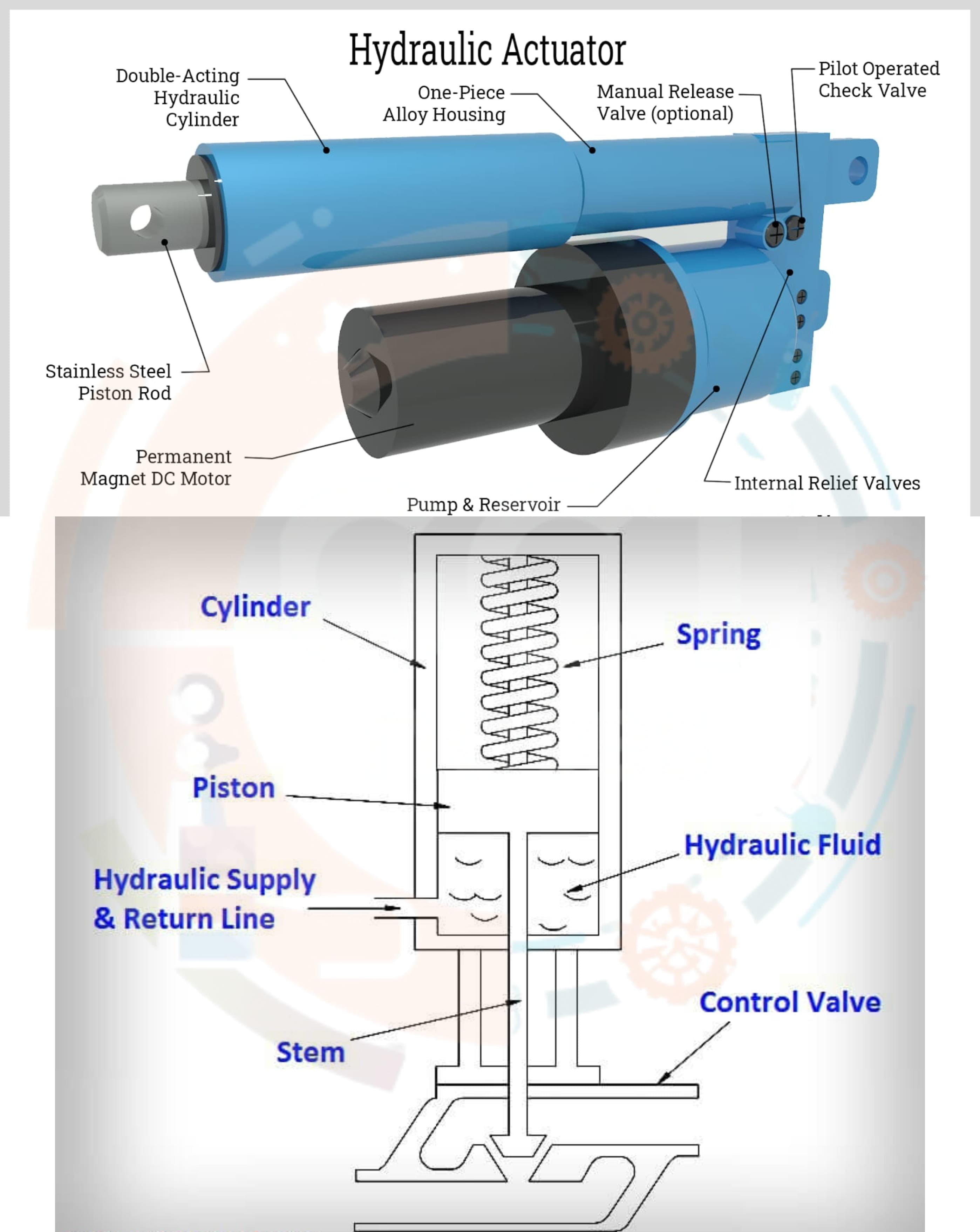
HYDRAULIC ACTUATORS
Other Chapters
INTRODUCTION TO HYDRAULICSHYDRO KINEMATICSFLOW THROUGH PIPESIMPACT OF JETWATER TURBINESPUMPSHYDRAULIC VALVES AND SEALSHYDRAULIC SIMPLE MACHINESHYDRAULIC ACTUATORSHYDRAULIC CIRCUITS AND ACCESSORIESPNEUMATIC SIMPLE MACHINES
- Q1: Define Hydraulic Actuator.Ans: A hydraulic actuator is a device that converts hydraulic energy (fluid pressure) into mechanical motion. It uses pressurized oil to produce movement and force. Hydraulic actuators are commonly used where heavy loads need to be moved with high power and smooth control.
- Q2: Name the types of Hydraulic Actuators.Ans: The main types of hydraulic actuators are:
- ➔ Linear Actuators (Hydraulic Cylinders)
- ➔ Rotary Actuators (Hydraulic Motors)
- Q3: What is a Rotary Actuator?Ans: A rotary actuator is a hydraulic device that converts hydraulic pressure into rotational (circular) motion. It produces torque and rotates a shaft. Rotary actuators are mainly used in machines where turning or spinning motion is required.
- Q4: State the classification of Rotary Actuators.Ans: The classification of Rotary Actuators are as follows:
- ➔ Gear Type Motors
- ➔ Vane Type Motors
- ➔ Piston Type Motors
- ➔ In-line Axis, Piston Type Motors
- ➔ Bent-Axis, Piston Type Motors
- Q5: What is Gear Type Motors?Ans: Gear type motors are hydraulic motors that use meshing gears to convert hydraulic pressure into rotary motion. When pressurized oil enters the motor, it rotates the gears, which in turn rotate the output shaft.
- Q6: Briefly explain the construction and working of Gear Type Motors.Ans: Construction: It consists of two meshing gears placed inside a closed housing. One gear is connected to the output shaft.
Working: When pressurized oil enters the motor, it pushes against the teeth of the gears. The gears rotate due to the force of the oil. As the gears rotate, oil moves around the casing and exits through the outlet. This rotation of gears produces mechanical power. - Q7: Write some uses of Gear Type Motors.Ans: Gear Type Motors are used in the followings:
- ➔ Conveyors
- ➔ Agricultural machines
- ➔ Machine tools
- ➔ Construction equipment
- Q8: What is Vane Type Motors?Ans: Vane type motors are hydraulic motors that use vanes mounted on a rotor to produce rotary motion. The vanes slide in and out of slots and rotate when pressurized oil enters the motor.
- Q9: Briefly explain the construction and working of Vane Type Motors.Ans: Construction: It consists of a rotor placed inside a cam ring. The rotor has slots in which vanes are fitted.
Working: When pressurized oil enters the motor, it pushes the vanes outward against the cam ring. The pressure difference causes the rotor to rotate. As the rotor turns, oil moves from inlet to outlet, producing rotary motion. - Q10: Write some uses of Vane Type Motors.Ans: Vane Type Motors are mostly used in the followings:
- ➔ Injection molding machines
- ➔ Industrial machinery
- ➔ Conveying systems
- ➔ Material handling equipment
- Q11: What is Piston Type Motors?Ans: Piston type motors are hydraulic motors that use pistons to convert hydraulic energy into rotary motion. The pistons move due to fluid pressure and cause the shaft to rotate. These motors are suitable for high-pressure and high-torque applications.
- Q12: Briefly explain the construction and working of Piston Type Motors.Ans: Construction: It consists of multiple pistons arranged inside a cylinder block. The pistons are connected to a shaft through a mechanism.
Working: When pressurized oil enters the motor, it pushes the pistons. The movement of pistons causes the cylinder block or shaft to rotate. Continuous oil flow keeps the rotation smooth and powerful. - Q13: Write some uses of Piston Type Motors.Ans: Piston Type Motors are used in the followings:
- ➔ Heavy construction equipment
- ➔ Cranes
- ➔ Excavators
- ➔ Mining machinery
- Q14: State the types of Piston Type Motors.Ans: The types of Piston Type Motors are:
- ➔ In-line Axis Piston Motors
- ➔ Bent-Axis Piston Motors
- Q15: What are In-line Axis, Piston Type Motors?Ans: In-line axis piston motors are piston motors in which the pistons are arranged parallel to the drive shaft. The cylinder block and shaft are in the same straight line. These motors are compact in design and widely used in hydraulic systems.
- Q16: What are Bent-Axis, Piston Type Motors?Ans: Bent-axis piston motors are piston motors in which the cylinder block is placed at an angle to the drive shaft. Because of this angle, the pistons move in a bent path. These motors can handle high pressure and produce high torque, making them suitable for heavy-duty applications.
- Q17: What is a Linear Actuator?Ans: A linear actuator is a hydraulic device that converts hydraulic energy into straight-line motion. It produces force in a linear direction (back and forth movement). Linear actuators are mainly used for lifting, pushing, pulling, or pressing heavy loads in machines.
- Q18: What are Hydraulic Motors?Ans: Hydraulic motors are devices that convert hydraulic energy (fluid pressure and flow) into rotary mechanical energy. They produce rotational motion and torque. Hydraulic motors are commonly used in machines where high power and smooth rotation are required.
- Q19: What are Hydraulic Pumps?Ans: Hydraulic pumps are devices that convert mechanical energy into hydraulic energy. They create flow of hydraulic fluid by drawing oil from a tank and delivering it under pressure to the system. Hydraulic pumps are the main source of power in a hydraulic system.
- Q20: Name the seals used in Hydraulic Motors.Ans: The seals used in Hydraulic Motors are as follows:
- ➔ O-Rings
- ➔ Oil Seals
- ➔ Shaft Seals
- ➔ Mechanical Seals
- ➔ Lip Seals
- Q21: State the classification of Reciprocating Actuators.Ans: The classification of Reciprocating Actuators is as follows:
- ➔ Single Acting Cylinder
- ➔ Double Acting Cylinder
- Q22: State the uses of Reciprocating Actuators.Ans: Reciprocating Actuators are used in the followings:
- ➔ Lifting heavy loads
- ➔ Pressing and punching operations
- ➔ Clamping workpieces
- ➔ Operating machine tools
- ➔ Material handling equipment
- Q23: Briefly explain the working principle of Reciprocating Actuators.Ans: Reciprocating actuators work on the principle of converting hydraulic pressure into linear motion. When pressurized oil enters the cylinder, it pushes the piston in one direction. When the oil is released or supplied on the opposite side, the piston moves back. This back and forth motion is called reciprocating motion.
- Q24: What is a Single Acting Cylinder?Ans: A single acting cylinder is a hydraulic cylinder in which hydraulic pressure is applied on only one side of the piston. It produces force in one direction only. The return movement is usually done by a spring or by external load.
- Q25: State the uses of Single Acting Cylinder.Ans: Single Acting Cylinder are used in the followings:
- ➔ Hydraulic jacks
- ➔ Lifting platforms
- ➔ Dump trucks
- ➔ Press machines (simple operations)
- Q26: Briefly explain the working principle of Single Acting Cylinder.Ans: In a single acting cylinder, pressurized oil enters from one side of the cylinder. The pressure pushes the piston forward and produces motion. When the oil is released, the piston returns to its original position by spring force or external load. Thus, power is applied in only one direction.
- Q27: What is a Double Acting Cylinder?Ans: A double acting cylinder is a hydraulic cylinder in which hydraulic pressure is applied on both sides of the piston. It can produce force in both forward and backward directions. This type of cylinder provides better control and efficiency.
- Q28: State the uses of Double Acting Cylinder.Ans: Double Acting Cylinder are used in the followings:
- ➔ Industrial machinery
- ➔ Excavators
- ➔ Cranes
- ➔ Manufacturing equipment
- ➔ Automated systems
- Q29: Briefly explain the working principle of Double Acting Cylinder.Ans: In a double acting cylinder, pressurized oil is supplied alternately to both sides of the piston. When oil enters one side, the piston moves forward. When oil is supplied to the other side, the piston moves backward. Since pressure is applied in both directions, the cylinder produces force during both strokes.
- Q30: What is a Differential Cylinder?Ans: A differential cylinder is a type of double acting hydraulic cylinder in which the piston rod is attached on one side of the piston. Because of the rod, the effective area on both sides of the piston is different. Due to this difference in area, the speed of extension and retraction is not the same.
- Q31: State the uses of Differential Cylinder.Ans: Differential Cylinder are used in the followings:
- ➔ Machine tools
- ➔ Hydraulic presses
- ➔ Material handling systems
- ➔ Industrial automation equipment
- Q32: Briefly explain the working principle of Differential Cylinder.Ans: In a differential cylinder, hydraulic oil is supplied to one side of the piston. Since the piston rod reduces the area on one side, the force and speed differ in extension and retraction. When oil enters the full piston area side, the cylinder moves slowly with high force. When oil enters the rod side, the cylinder moves faster but produces less force.
- Q33: What is a Non-Differential Cylinder?Ans: A non-differential cylinder is a hydraulic cylinder in which the effective piston area is the same on both sides. This type of cylinder provides equal force and equal speed in both forward and backward movements. It is specially designed to maintain uniform performance in both directions.
- Q34: State the uses of Non-Differential Cylinder.Ans: Non-Differential Cylinder are used in the followings:
- ➔ Precision machinery
- ➔ Position control systems
- ➔ Testing equipment
- ➔ Industrial automation
- Q35: Briefly explain the working principle of Non-Differential Cylinder.Ans: In a non-differential cylinder, hydraulic oil is supplied alternately to both sides of the piston. Since both sides have equal effective area, the force and speed remain the same in both directions. This ensures balanced and smooth reciprocating motion.
- Q36: What is a Ram Type Cylinder?Ans: A ram type cylinder is a hydraulic cylinder that has a large diameter rod and no piston inside the cylinder. The ram itself acts as the piston. It is mainly used for lifting heavy loads with high force.
- Q37: State the uses of Ram Type Cylinder.Ans: Ram Type Cylinder are used in the followings:
- ➔ Hydraulic jacks
- ➔ Lifting platforms
- ➔ Elevators
- ➔ Heavy load lifting systems
- Q38: Briefly explain the working principle of Ram Type Cylinder.Ans: In a ram type cylinder, pressurized oil enters the cylinder and pushes the ram upward. Since the ram has a large surface area, it produces a high lifting force. When the oil is released, the ram returns to its original position due to gravity or external load.
- Q39: What is a Piston Type Cylinder?Ans: A piston type cylinder is a hydraulic cylinder that contains a piston attached to a piston rod inside the cylinder. The piston divides the cylinder into two chambers. It is widely used for producing linear motion in hydraulic systems.
- Q40: State the uses of Piston Type Cylinder.Ans: Piston Type Cylinder are used in the followings:
- ➔ Excavators
- ➔ Cranes
- ➔ Press machines
- ➔ Industrial machinery
- Q41: Briefly explain the working principle of Piston Type Cylinder.Ans: In a piston type cylinder, hydraulic oil is supplied to one side of the piston. The pressure pushes the piston and rod to move in a straight line. When oil is supplied to the opposite side, the piston moves in the reverse direction. This produces reciprocating motion.
- Q42: What is a Cushion Cylinder?Ans: A cushion cylinder is a hydraulic cylinder provided with a cushioning mechanism at the end of its stroke. It reduces the speed of the piston before it reaches the end position. This prevents shock and damage to the cylinder and machine parts.
- Q43: State the uses of Cushion Cylinder.Ans: Cushion Cylinder are used in the followings:
- ➔ High-speed machinery
- ➔ Industrial automation
- ➔ Machine tools
- ➔ Heavy-duty equipment
- Q44: Briefly explain the working principle of Cushion Cylinder.Ans: In a cushion cylinder, as the piston approaches the end of its stroke, the oil outlet is gradually restricted. This restriction slows down the piston movement. The reduced speed prevents sudden impact and ensures smooth stopping of the piston.
- Q45: What is a Lockout Cylinder?Ans: A lockout cylinder is a hydraulic cylinder designed to hold the piston in a fixed position under load. It prevents movement even if there is pressure loss. This type of cylinder ensures safety and stability in hydraulic systems.
- Q46: State the uses of Lockout Cylinder.Ans: Lockout Cylinder are used in the followings:
- ➔ Lifting equipment
- ➔ Hydraulic presses
- ➔ Construction machinery
- ➔ Safety holding systems
- Q47: Briefly explain the working principle of Lockout Cylinder.Ans: In a lockout cylinder, special locking mechanisms or valves are provided. When the desired position is reached, the lock prevents the piston from moving. Even if hydraulic pressure drops, the piston remains in position, ensuring safety and load holding.