HYDRAULIC SIMPLE MACHINES
Other Chapters
INTRODUCTION TO HYDRAULICSHYDRO KINEMATICSFLOW THROUGH PIPESIMPACT OF JETWATER TURBINESPUMPSHYDRAULIC VALVES AND SEALSHYDRAULIC SIMPLE MACHINESHYDRAULIC ACTUATORSHYDRAULIC CIRCUITS AND ACCESSORIESPNEUMATIC SIMPLE MACHINES
- Q1: Define Simple Machines.Ans: Simple machines are basic mechanical devices that make work easier by changing the size or direction of a force. They do not create energy, but they help us apply force more effectively. Examples include lever, pulley, wheel and axle, inclined plane, screw, and wedge.
- Q2: Define Simple Hydraulic Machines.Ans: Simple hydraulic machines are devices that use liquid pressure to transmit force from one point to another. They work on the principle that pressure applied to a confined liquid is transmitted equally in all directions. These machines help in lifting heavy loads with less effort.
- Q3: Name the types of Hydraulic Machines.Ans: The types of Hydraulic Machines are as follows:
- ➔ Hydraulic Press
- ➔ Hydraulic Jack
- ➔ Hydraulic Lift
- ➔ Hydraulic Crane
- ➔ Hydraulic Ram
- ➔ Hydraulic Accumulator
- ➔ Hydraulic Intensifier
- ➔ Hydraulic Brake
- ➔ Hydraulic Pump
- ➔ Hydraulic Turbine
- Q4: What is Hydraulic Press?Ans: A hydraulic press is a machine that uses liquid pressure to produce a large compressive force. It works on Pascal’s Law, which states that pressure applied to a confined liquid is transmitted equally in all directions. It is used for pressing, molding, punching, and compressing materials.
- Q5: Briefly state the construction of Hydraulic Press.Ans: A hydraulic press consists of two cylinders of different sizes connected by a pipe. Each cylinder has a piston fitted inside it. The cylinders are filled with oil or any hydraulic fluid. The smaller piston is called the plunger, and the larger piston is called the ram. When force is applied on the small piston, pressure is transmitted to the large piston to lift heavy loads.
- Q6: Briefly state the working principle of Hydraulic Press.Ans: The hydraulic press works on Pascal’s Law. When a small force F1 is applied on the small piston of area A1, pressure is produced in the liquid. This pressure is transmitted equally to the larger piston of area A2. The force produced on the large piston is F2. The relation is:
F1 / A1 = F2 / A2
Since A2 is larger, F2 becomes much greater than F1, which helps in lifting heavy loads. - Q7: State any four mechanical advantages of Hydraulic Press.Ans: The mechanical advantages of a hydraulic press are:
- ➔ It can produce very large force with small effort.
- ➔ It provides smooth and uniform pressure.
- ➔ It is simple in construction.
- ➔ It requires less manual labor.
- Q8: What is Hydraulic Ram?Ans: A hydraulic ram is a device used to lift water from a lower level to a higher level without using external power. It works by using the energy of flowing water. It is mainly used in rural areas where electricity is not available.
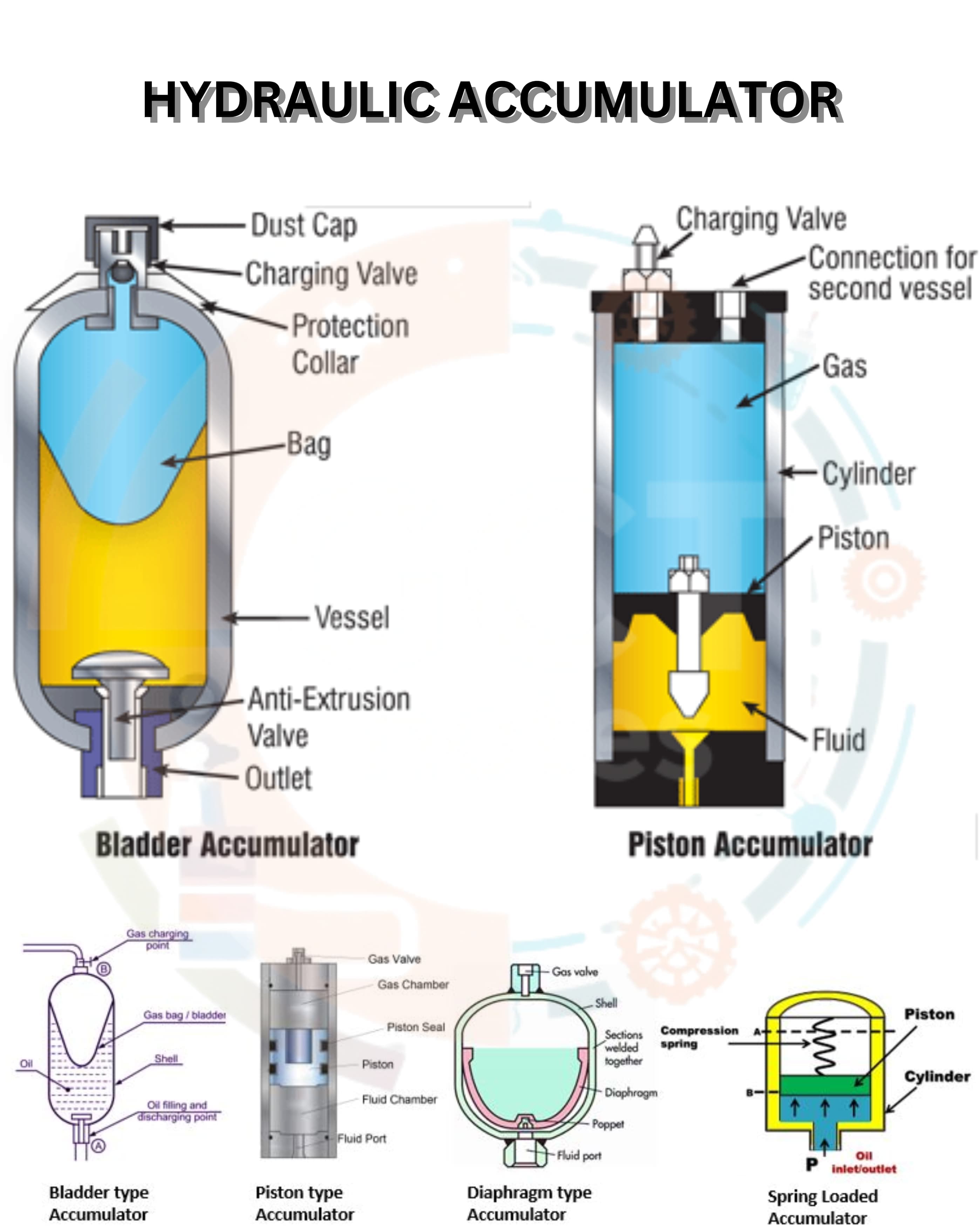
- Q9: What is a Hydraulic Accumulator?Ans: A hydraulic accumulator is a device used to store hydraulic energy in the form of pressurized fluid. It stores excess energy and supplies it when required. It helps in maintaining constant pressure in hydraulic systems.
- Q10: Name the types of Hydraulic Accumulator.Ans: The types of Hydraulic Accumulator are:
- ➔ Simple Hydraulic Accumulator
- ➔ Differential Hydraulic Accumulator
- Q11: What is a Simple Hydraulic Accumulator?Ans: A simple hydraulic accumulator is a device that stores energy by using a heavy weight placed on a piston. When fluid enters the cylinder, it lifts the piston and weight. The stored energy is released when the fluid is required in the system.
- Q12: What is a Differential Hydraulic Accumulator?Ans: A differential hydraulic accumulator is an improved type of accumulator that uses a ram and a cylinder arrangement. It produces higher pressure compared to a simple accumulator. It is more compact and efficient in storing hydraulic energy.
- Q13: Briefly state the construction of Hydraulic Accumulator.Ans: A hydraulic accumulator consists of a strong vertical cylinder and a movable piston or ram inside it. A heavy weight is placed on the piston. The cylinder is connected to the hydraulic system through pipes. When fluid enters, it lifts the piston and stores energy in the form of pressure.
- Q14: Briefly state the working principle of Hydraulic Accumulator.Ans: The hydraulic accumulator works on the principle of storing energy in the form of pressurized fluid. When excess fluid enters the cylinder, it lifts the weighted piston and stores energy. When the system needs energy, the weight pushes the piston downward and forces the fluid back into the system at required pressure.
- Q15: State any four mechanical advantages of Hydraulic Accumulator.Ans: The mechanical advantages of a hydraulic accumulator are:
- ➔ It stores excess hydraulic energy.
- ➔ It maintains constant pressure in the system.
- ➔ It reduces load on the pump.
- ➔ It improves efficiency of hydraulic machines.
- Q16: What is Hydraulic Crane?Ans: A hydraulic crane is a lifting machine that uses hydraulic pressure to lift and move heavy loads. It works on Pascal’s Law, where pressure applied to a confined fluid is transmitted equally in all directions. The hydraulic system multiplies the applied force, allowing the crane to lift heavy objects with less effort. It is commonly used in construction sites, workshops, and industries.
- Q17: State any four advantages of Hydraulic Crane.Ans: The advantages of a hydraulic crane are:
- ➔ It can lift very heavy loads with small effort.
- ➔ It provides smooth and controlled lifting.
- ➔ It requires less manual labor.
- ➔ It is easy to operate and maintain.
- Q18: What is Hydraulic Lift?Ans: A hydraulic lift is a device used to raise or lower heavy loads or persons using hydraulic pressure. It consists of a cylinder and piston arrangement filled with hydraulic fluid. When pressure is applied to the fluid, the piston moves upward and lifts the load. It is widely used in elevators, garages, and service stations.
- Q19: State any four advantages of Hydraulic Lift.Ans: The advantages of a hydraulic lift are:
- ➔ It can lift heavy loads smoothly.
- ➔ It provides safe and stable operation.
- ➔ It requires less space for installation.
- ➔ It is simple in construction.
- Q20: What is Hydraulic Intensifier?Ans: A hydraulic intensifier is a device used to increase the pressure of a liquid. It converts low-pressure fluid into high-pressure fluid by using pistons of different areas. It works on the principle that pressure is inversely proportional to area when force is constant. It is used where high pressure is required but only low-pressure supply is available.
- Q21: State any four advantages of Hydraulic Intensifiers.Ans: The advantages of a hydraulic intensifier are:
- ➔ It increases fluid pressure effectively.
- ➔ It is useful when high pressure is required.
- ➔ It is compact in size.
- ➔ It improves efficiency of hydraulic systems.
- Q22: What is Hydraulic Coupling?Ans: A hydraulic coupling is a device used to transmit power from one shaft to another using fluid. It consists of a pump and a turbine enclosed in a casing filled with oil. When the driving shaft rotates, it moves the fluid, which in turn rotates the driven shaft.
- Q23: State any four advantages of Hydraulic Coupling.Ans: The advantages of a hydraulic coupling are:
- ➔ It provides smooth power transmission.
- ➔ It reduces shock and vibration.
- ➔ It protects the system from overload.
- ➔ It requires less maintenance.
- Q24: What is a Hydraulic Torque Converter?Ans: A hydraulic torque converter is a type of fluid coupling that can multiply torque. It is used mainly in automatic vehicles. It consists of a pump, turbine, and stator enclosed in a casing filled with fluid.
- Q25: State any four advantages of Hydraulic Torque Converter.Ans: The advantages of a hydraulic torque converter are:
- ➔ It multiplies torque automatically.
- ➔ It provides smooth and shock-free operation.
- ➔ It improves vehicle performance.
- ➔ It reduces engine stalling.
- Q26: What is Jet Pump?Ans: A jet pump is a device used to lift liquids by using the energy of a high-speed jet of fluid. It works on the principle of momentum transfer. The high-speed jet creates a low-pressure area that draws liquid from a lower level and pushes it to a higher level.
- Q27: State any four advantages of Jet Pump.Ans: The advantages of a jet pump are:
- ➔ It has simple construction.
- ➔ It has no moving parts.
- ➔ It requires less maintenance.
- ➔ It can handle dirty or sandy water.
- Q28: What is an Air Lift Pump?Ans: An air lift pump is a device used to lift water by injecting compressed air into a pipe placed in the water. The air mixes with water, reducing its density, and the mixture rises to the surface. It is commonly used in wells and boreholes.
- Q29: State any four advantages of Air Lift Pump.Ans: The advantages of an air lift pump are:
- ➔ It has simple design and construction.
- ➔ It can handle dirty water.
- ➔ It has low maintenance cost.
- ➔ It is suitable for deep wells.