INTRODUCTION TO HYDRAULICS
Other Chapters
INTRODUCTION TO HYDRAULICSHYDRO KINEMATICSFLOW THROUGH PIPESIMPACT OF JETWATER TURBINESPUMPSHYDRAULIC VALVES AND SEALSHYDRAULIC SIMPLE MACHINESHYDRAULIC ACTUATORSHYDRAULIC CIRCUITS AND ACCESSORIESPNEUMATIC SIMPLE MACHINES
- Q1: Define Hydraulics.Ans: Hydraulics is the branch of science and engineering that deals with the study of liquids at rest and in motion. It mainly deals with the use of liquid pressure to perform work and transmit power.
- Q2: Define Hydraulic Machines.Ans: Hydraulic machines are machines that use the energy of flowing or stored water (liquid) to perform useful work. These machines convert hydraulic energy into mechanical energy or mechanical energy into hydraulic energy.
- Q3: Define Hydraulic System.Ans: A hydraulic system is a system that uses pressurized liquid to transmit power from one place to another. It consists of a pump, pipes, valves, and actuators to control and use the liquid power.
- Q4: State the three states of matter.Ans: The three states of matter are:
- ➔ Solid
- ➔ Liquid
- ➔ Gas
- Q5: Differentiate between Fluid and Liquid.Ans: Fluid is a substance that can flow. It includes both liquids and gases. Liquid is a type of fluid that has definite volume but no definite shape.
- ➔ Fluid can be liquid or gas.
- ➔ Liquid is only one type of fluid.
- ➔ Liquid has definite volume.
- ➔ Gas does not have definite volume.
- Q6: Name the types of fluid.Ans: The types of fluid are:
- ➔ Ideal Fluid
- ➔ Real Fluid
- ➔ Newtonian Fluid
- ➔ Non-Newtonian Fluid
- Q7: Define Flow of Fluid.Ans: Flow of fluid is the continuous movement of liquid or gas from one place to another due to pressure difference.
- Q8: State 4 properties of Liquid.Ans: Four properties of liquid are:
- ➔ Definite volume
- ➔ No definite shape
- ➔ Slightly compressible
- ➔ Has viscosity
- Q9: State 4 properties of Fluid.Ans: Four properties of fluid are:
- ➔ Can flow
- ➔ Has density
- ➔ Has viscosity
- ➔ Exerts pressure
- Q10: What are Intermolecular Forces?Ans: Intermolecular forces are the forces of attraction or repulsion between the molecules of a substance. These forces hold the molecules together.
- Q11: Define Density.Ans: Density is the mass per unit volume of a substance.
Formula: Density = Mass / Volume
ρ = m / V - Q12: If 2.4m3 of a certain oil has a mass of 2 tonnes, find its mass density.Ans: Given:
Mass = 2 tonnes = 2000 kg
Volume = 2.4 m3
Formula: ρ = m / V
ρ = 2000 / 2.4
ρ = 833.33 kg/m3
Therefore, the mass density of oil is 833.33 kg/m3. - Q13: Define Specific Weight.Ans: Specific weight is the weight per unit volume of a substance.
Formula: Specific Weight = Weight / Volume
γ = W / V - Q14: In an experiment the weight of 2.5m3 liquid was found to be 18.75KN. Find specific weight of the liquid.Ans: Given:
Weight = 18.75 kN
Volume = 2.5 m3
Formula: γ = W / V
γ = 18.75 / 2.5
γ = 7.5 kN/m3
Therefore, specific weight of liquid is 7.5 kN/m3. - Q15: Find the specific gravity of an oil whose specific weight is 7.85KN/m3.Ans: Formula: Specific Gravity = Specific weight of liquid / Specific weight of water
Specific weight of water = 9.81 kN/m3
SG = 7.85 / 9.81
SG = 0.8
Therefore, specific gravity of oil is 0.8. - Q16: Define Viscosity.Ans: Viscosity is the property of a fluid which offers resistance to flow. It is the internal friction between the layers of fluid.
- Q17: Write unit and formula of Viscosity.Ans: Formula: τ = μ (du/dy)
Where μ is coefficient of viscosity.
SI unit of viscosity is N·s/m2 or Pa·s. - Q18: Define Ideal Fluid.Ans: An ideal fluid is a fluid which has no viscosity and is incompressible. It offers no resistance to flow.
- Q19: Define Capillarity.Ans: Capillarity is the rise or fall of a liquid in a thin tube due to surface tension.
- Q20: Define Capillary Action.Ans: Capillary action is the movement of liquid in a narrow tube caused by adhesion and cohesion forces.
- Q21: Define Compressibility.Ans: Compressibility is the property of a substance by which its volume decreases when pressure is applied.
- Q22: Define Surface Tension.Ans: Surface tension is the property of a liquid by which its free surface acts like a stretched elastic membrane.
- Q23: Why does rain drop have a spherical shape?Ans: Rain drops have a spherical shape due to surface tension. Surface tension tries to reduce the surface area of the liquid, and sphere has the minimum surface area. Therefore, rain drops become spherical.
- Q24: Define Vapour Pressure.Ans: Vapour pressure is the pressure exerted by vapour molecules when a liquid is in equilibrium with its vapour.
- Q25: Define Cohesion.Ans: Cohesion is the force of attraction between the molecules of the same substance.
- Q26: Define Adhesion.Ans: Adhesion is the force of attraction between molecules of different substances.
- Q27: State some effects of change of viscosity on change of temperature.Ans: The viscosity of a fluid changes when temperature changes.
- ➔ When temperature increases, viscosity of liquid decreases.
- ➔ When temperature decreases, viscosity of liquid increases.
- ➔ In gases, viscosity increases with increase in temperature.
- ➔ Change in viscosity affects flow and lubrication quality.
- Q28: What are Hydraulic Oils? Name some.Ans: Hydraulic oils are special oils used in hydraulic systems to transmit power and reduce wear between moving parts.
Some examples are:- ➔ Mineral Oil
- ➔ Synthetic Oil
- ➔ Water Glycol Oil
- ➔ Phosphate Ester Oil
- Q29: Write 4 uses of Hydraulic Oils.Ans: Four uses of hydraulic oils are:
- ➔ To transmit power in hydraulic systems
- ➔ To lubricate moving parts
- ➔ To cool the system
- ➔ To prevent corrosion and wear
- Q30: What are Lubricating Oils? Name some.Ans: Lubricating oils are oils used to reduce friction and wear between moving machine parts.
Some examples are:- ➔ Engine Oil
- ➔ Gear Oil
- ➔ Turbine Oil
- ➔ Compressor Oil
- Q31: Write 4 uses of Lubricating Oils.Ans: Four uses of lubricating oils are:
- ➔ To reduce friction
- ➔ To reduce wear and tear
- ➔ To cool engine parts
- ➔ To prevent rust and corrosion
- Q32: Name 4 properties of Hydraulic Oils.Ans: Four properties of hydraulic oils are:
- ➔ Proper viscosity
- ➔ High flash point
- ➔ Good oxidation stability
- ➔ Good lubrication property
- Q33: Name 4 properties of Lubricating Oils.Ans: Four properties of lubricating oils are:
- ➔ Suitable viscosity
- ➔ High boiling point
- ➔ Low pour point
- ➔ Good chemical stability
- Q34: What does API stand for?Ans: In Hydraulics, API stands for American Petroleum Institute.
- Q35: Define Laminar Flow of a viscous fluid.Ans: Laminar flow is the type of flow in which fluid particles move in smooth, parallel layers without mixing with each other. It usually occurs at low velocity.
- Q36: Name the types of leakage in Hydraulic Systems.Ans: The types of leakage in Hydraulic Systems are as follows:
- ➔ Planned Leakage
- ➔ Occasional Leakage
- Q37: Define Planned Leakage.Ans: Planned leakage is the small and controlled leakage provided in hydraulic components for lubrication and smooth movement of parts.
- Q38: Define Occasional Leakage.Ans: Occasional leakage is the unwanted leakage that occurs due to wear, damage, loose fittings, or seal failure in a hydraulic system.
- Q39: What does OEM stand for?Ans: In Hydraulics, OEM stands for Original Equipment Manufacturer.
- Q40: Define Pressure. Write its formula.Ans: Pressure is the force acting per unit area.
Formula: Pressure = Force / Area
P = F / A - Q41: Define Pressure Head. Write its formula.Ans: Pressure head is the height of liquid column equivalent to the pressure at a point.
Formula: Pressure Head = Pressure / (Density × g)
h = P / (ρg) - Q42: Find the pressure at a point of 4 meters below the free surface of water.Ans: Given:
h = 4 m
ρ (water) = 1000 kg/m3
g = 9.81 m/s2
Formula: P = ρgh
P = 1000 × 9.81 × 4
P = 39240 N/m2
Therefore, pressure at 4 m depth is 39240 N/m2 or 39.24 kPa. - Q43: What is Pascal’s Law?Ans: Pascal’s Law states that when pressure is applied to a confined liquid, it is transmitted equally and undiminished in all directions. This principle is used in hydraulic machines.
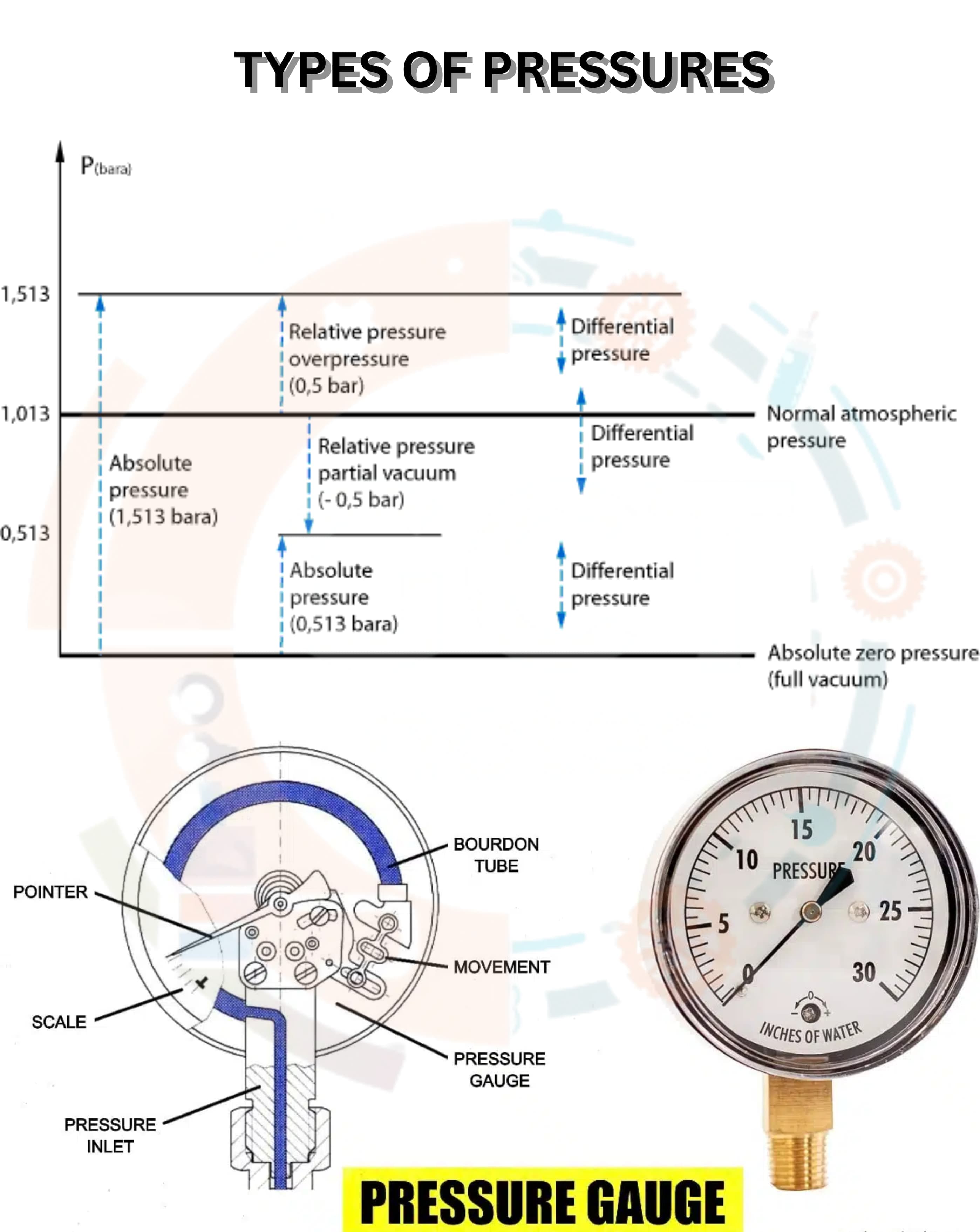
- Q44: Name the types of Pressure.Ans: The types of pressure are:
- ➔ Atmospheric Pressure
- ➔ Gauge Pressure
- ➔ Absolute Pressure
- ➔ Vacuum Pressure
- Q45: Define Atmospheric Pressure.Ans: Atmospheric pressure is the pressure exerted by the weight of air present in the atmosphere on the earth’s surface. Its average value at sea level is 101325 N/m2.
- Q46: Define Gauge Pressure.Ans: Gauge pressure is the pressure measured above or below atmospheric pressure. It is the difference between absolute pressure and atmospheric pressure.
- Q47: Define Positive Gauge Pressure.Ans: Positive gauge pressure is the pressure which is greater than atmospheric pressure. It indicates pressure above atmospheric level.
- Q48: Define Negative Gauge Pressure.Ans: Negative gauge pressure is the pressure which is less than atmospheric pressure. It is also called vacuum pressure.
- Q49: Define Absolute Pressure.Ans: Absolute pressure is the total pressure measured from absolute zero pressure.
Formula: Absolute Pressure = Atmospheric Pressure + Gauge Pressure
Pabsolute = Patm + Pgauge - Q50: Name some Pressure Measurement Techniques.Ans: Some pressure measurement techniques are:
- ➔ Piezometer Tube
- ➔ Manometer
- ➔ Bourdon Tube Gauge
- ➔ Diaphragm Gauge
- ➔ Dead Weight Pressure Gauge
- Q51: What are Tube Gauges?Ans: Tube gauges are pressure measuring devices that use liquid columns inside tubes to measure pressure. They work on the principle of balancing liquid column height with pressure.
- Q52: Write the working principle of Tube Gauges.Ans: Tube gauges work on the principle that pressure applied at a point in a liquid produces a rise or fall in the liquid column. The height of the liquid column indicates the pressure value.
- Q53: What are Mechanical Gauges?Ans: Mechanical gauges are pressure measuring devices that use mechanical parts like springs, tubes, or diaphragms to measure pressure. They convert pressure into mechanical movement.
- Q54: Write the working principle of Mechanical Gauges.Ans: Mechanical gauges work on the principle that when pressure is applied, it causes deformation or movement of an elastic element. This movement is converted into pointer movement on a calibrated scale to show pressure.
- Q55: Define Piezometer Tube.Ans: A piezometer tube is a simple vertical transparent tube used to measure liquid pressure at a point in a pipe. The height of liquid in the tube shows the pressure head.
- Q56: What is Diaphragm Pressure Gauge?Ans: A diaphragm pressure gauge is a device that uses a flexible metal diaphragm to measure pressure. When pressure is applied, the diaphragm deflects and moves a pointer on the scale.
- Q57: What is Bourdon Tube Pressure Gauge?Ans: A Bourdon tube pressure gauge is a mechanical device that uses a curved elastic tube. When pressure enters the tube, it tries to straighten, and this movement is used to indicate pressure on a dial.
- Q58: What is Dead Weight Pressure Gauge?Ans: A dead weight pressure gauge is a device used to measure and calibrate pressure accurately. It works by balancing the applied pressure with known weights placed on a piston.