PUMPS
Other Chapters
INTRODUCTION TO HYDRAULICSHYDRO KINEMATICSFLOW THROUGH PIPESIMPACT OF JETWATER TURBINESPUMPSHYDRAULIC VALVES AND SEALSHYDRAULIC SIMPLE MACHINESHYDRAULIC ACTUATORSHYDRAULIC CIRCUITS AND ACCESSORIESPNEUMATIC SIMPLE MACHINES
- Q1: Define Pump.Ans: A pump is a mechanical device used to move liquids from one place to another by increasing their pressure or velocity.
- Q2: Write 2 uses of Pumps.Ans: Uses of pumps include:
- ➔ To supply water for domestic, industrial, or irrigation purposes.
- ➔ To circulate water in power plants, heating, and cooling systems.
- Q3: Briefly explain the working of a Pump.Ans: A pump works by creating a pressure difference between its inlet and outlet. Liquid enters the suction pipe at low pressure, energy is added by the pump, and liquid is discharged at higher pressure through the delivery pipe.
- Q4: State the classification of Pumps.Ans: Pumps are classified as:
- ➔ Centrifugal Pump
- ➔ Reciprocating Pump
- ➔ Rotary Pump
- ➔ Jet Pump
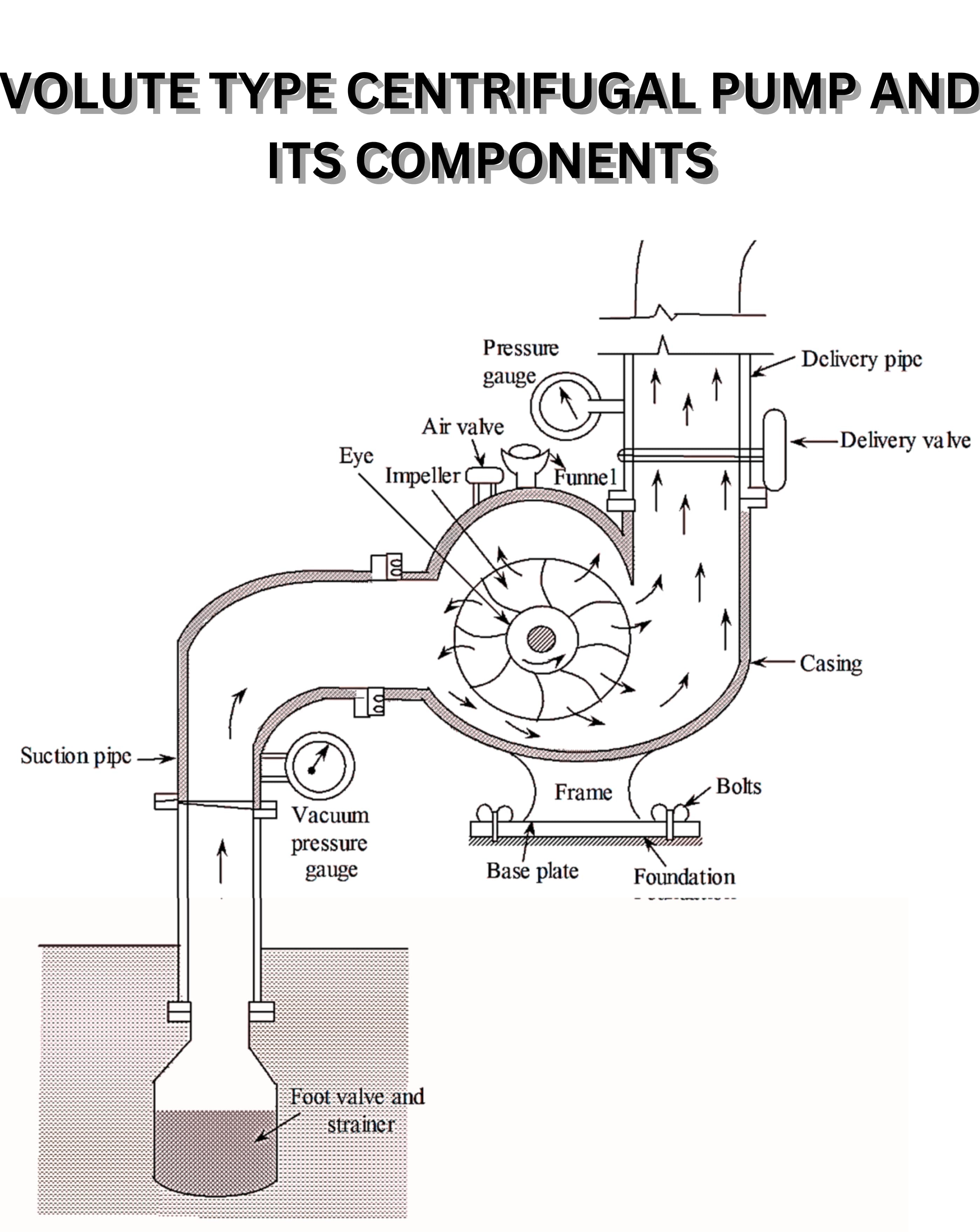
- Q5: Define Centrifugal Pump.Ans: A centrifugal pump is a pump that uses a rotating impeller to impart velocity to the liquid, which is then converted into pressure to move the liquid.
- Q6: Briefly explain the working principle of a Centrifugal Pump.Ans: In a centrifugal pump, liquid enters the center of a rotating impeller. The impeller blades throw the liquid outward by centrifugal force, increasing its velocity. This velocity is converted into pressure in the pump casing, and liquid is discharged.
- Q7: Define Reciprocating Pump.Ans: A reciprocating pump is a positive displacement pump in which a piston or plunger moves back and forth inside a cylinder to suck and discharge liquid.
- Q8: Name some components of Reciprocating Pump.Ans: Components of a reciprocating pump include:
- ➔ Cylinder
- ➔ Piston or Plunger
- ➔ Suction and Delivery Valves
- ➔ Connecting Rod and Crank
- ➔ Pump Casing
- Q9: Briefly explain the working principle of a Reciprocating Pump.Ans: In a reciprocating pump, the piston moves backward, creating suction and drawing liquid into the cylinder through the suction valve. During forward stroke, the piston pushes the liquid out through the delivery valve at higher pressure.
- Q10: State the classification of Centrifugal Pump.Ans: The classification of centrifugal pumps is as follows:
- According to Casing:
- ➔ Volute Pumps
- ➔ Turbine Pumps
- ➔ Diffusion Pumps
- According to Working Head:
- ➔ Low Head Centrifugal Pump
- ➔ Medium Head Centrifugal Pump
- ➔ High Head Centrifugal Pump
- According to Liquid Handled:
- ➔ Closed Impeller Pump
- ➔ Open Impeller Pump
- ➔ Semi Open Impeller Pump
- According to Number of Impellers per shaft:
- ➔ Single Stage Centrifugal Pump
- ➔ Double Stage Centrifugal Pump
- According to Number of Entrances to the Impeller:
- ➔ Single Suction Pump
- ➔ Double Suction Pump
- According to Direction of Flow through Impeller:
- ➔ Radial Flow Pump
- ➔ Axial Flow Pump
- ➔ Mixed Flow Pump
- According to Casing:
- Q11: State some components of Centrifugal Pump.Ans: Some important components of a centrifugal pump are:
- ➔ Impeller
- ➔ Pump Casing (Volute or Vortex)
- ➔ Shaft
- ➔ Bearings
- ➔ Suction and Delivery Nozzles
- ➔ Mechanical Seal or Packing
- Q12: What is an Impeller?Ans: An impeller is a rotating component of a centrifugal pump that imparts velocity to the liquid. It converts mechanical energy from the shaft into kinetic energy of the fluid.
- Q13: What is a Vortex Casing?Ans: A vortex casing is a type of pump casing where the liquid moves in a spiral path around the impeller before leaving the pump. It reduces losses and provides smooth flow to the discharge nozzle.
- Q14: Define Volute Pumps.Ans: Volute pumps have a spiral-shaped casing that gradually increases in area from the impeller to the discharge. This design converts velocity into pressure efficiently.
- Q15: Define Turbine Pumps.Ans: Turbine pumps are vertical centrifugal pumps used for high head applications. They lift water from deep wells or reservoirs using a vertical shaft and multiple impellers.
- Q16: Define Diffusion Pumps.Ans: Diffusion pumps are centrifugal pumps with specially designed casings that slow down the velocity of the liquid gradually. They are used for high-pressure applications with low flow rates.
- Q17: Define Single Suction Pump.Ans: A single suction pump is a centrifugal pump in which liquid enters the impeller from only one side of the impeller.
- Q18: Define Double Suction Pump.Ans: A double suction pump is a centrifugal pump in which liquid enters the impeller from both sides simultaneously. This balances axial thrust and improves efficiency.
- Q19: Define Low Head Centrifugal Pump.Ans: Low head centrifugal pumps are designed for applications with small head (pressure) and high flow rate. They are typically used for irrigation, drainage, or circulation purposes.
- Q20: Define Medium Head Centrifugal Pump.Ans: Medium head centrifugal pumps are used for applications with moderate head and flow. They are commonly used in industrial water supply, fire protection, and municipal systems.
- Q21: Define High Head Centrifugal Pump.Ans: High head centrifugal pumps are designed to deliver water at high pressure with low to moderate flow. They are used in hydroelectric plants, boiler feed systems, and high-pressure applications.
- Q22: Define Closed Impeller Pump.Ans: A closed impeller pump is a centrifugal pump in which the impeller is enclosed on both sides by shrouds or covers. This design reduces leakage and improves efficiency.
- Q23: Define Open Impeller Pump.Ans: An open impeller pump is a centrifugal pump in which the impeller has no shrouds, and the blades are exposed. It is suitable for handling liquids containing solids or slurry.
- Q24: Define Semi Open Impeller Pump.Ans: A semi open impeller pump has a shroud on one side of the impeller while the other side is open. It combines the benefits of closed and open impellers, allowing some solid handling with better efficiency.
- Q25: Define Single Stage Centrifugal Pump.Ans: A single stage centrifugal pump is a pump that has only one impeller on its shaft. It is used for moderate head and flow applications.
- Q26: Define Double Stage Centrifugal Pump.Ans: A double stage centrifugal pump has two impellers mounted in series on the same shaft. It is used to achieve higher head than a single stage pump.
- Q27: State the classification of Reciprocating Pump.Ans: The classification of reciprocating pumps is as follows:
- According to Action of Water:
- ➔ Single Acting Pumps
- ➔ Double Acting Pumps
- According to Number of Cylinders:
- ➔ Single Cylinder Pump
- ➔ Double Cylinder Pump
- ➔ Triple Cylinder Pump
- According to Existence of Air Vessels:
- ➔ With Air Vessels
- ➔ Without Air Vessels
- According to Action of Water:
- Q28: What are Single Acting Pumps?Ans: Single acting pumps are reciprocating pumps in which the piston delivers water only during one stroke (usually the forward stroke) and suction occurs during the other stroke.
- Q29: What are Double Acting Pumps?Ans: Double acting pumps are reciprocating pumps in which the piston delivers water during both forward and backward strokes. This provides a more continuous and smoother flow.
- Q30: What are Single Cylinder Pumps?Ans: Single cylinder pumps are reciprocating pumps that have only one cylinder. They deliver water through a single piston or plunger and are used for moderate flow and pressure.
- Q31: What are Double Cylinder Pumps?Ans: Double cylinder pumps are reciprocating pumps with two cylinders. They provide smoother discharge and higher capacity than single cylinder pumps, as one piston can deliver while the other is in suction stroke.
- Q32: What are Triple Cylinder Pumps?Ans: Triple cylinder pumps have three cylinders. They give nearly continuous flow and are used where large capacity and uniform discharge are required.
- Q33: What is Slip of Pump?Ans: Slip of a pump is the difference between the theoretical discharge and the actual discharge of a pump.
Slip = Theoretical Discharge − Actual Discharge - Q34: What is a Vane Pump?Ans: A vane pump is a type of positive displacement pump in which vanes mounted on a rotor slide in and out to move the liquid from suction to discharge.
- Q35: Briefly explain the working of Vane Pump.Ans: In a vane pump, the rotor rotates inside a cam ring. The vanes slide outward due to centrifugal force, trapping liquid in the spaces between vanes. The liquid is carried from the suction side to the discharge side, creating flow.
- Q36: What is a Gear Pump?Ans: A gear pump is a positive displacement pump in which liquid is trapped between the teeth of two meshing gears and carried from suction to discharge.
- Q37: Briefly explain the working of Gear Pump.Ans: In a gear pump, one gear is driven by a motor and the other is driven by meshing. Liquid enters the spaces between teeth at the suction side and is carried around the casing to the discharge side, where it is pushed out.
- Q38: What are Cavitations in Pumps?Ans: Cavitations in pumps are the formation and sudden collapse of vapor bubbles in the liquid due to local low pressure. They cause noise, vibration, and damage to pump components.
- Q39: State some remedies for Cavitations in Pumps.Ans: Remedies for cavitation include:
- ➔ Increase the suction head or inlet pressure.
- ➔ Reduce pump speed.
- ➔ Use a pump with larger suction diameter.
- ➔ Lower the temperature of the liquid to reduce vapor formation.
- Q40: What is NPSH?Ans: NPSH (Net Positive Suction Head) is the absolute pressure at the suction of a pump above the vapor pressure of the liquid.
It ensures that the liquid does not cavitate.
NPSH = (Absolute Suction Head − Vapor Pressure Head)