HYDRO KINEMATICS
Other Chapters
INTRODUCTION TO HYDRAULICSHYDRO KINEMATICSFLOW THROUGH PIPESIMPACT OF JETWATER TURBINESPUMPSHYDRAULIC VALVES AND SEALSHYDRAULIC SIMPLE MACHINESHYDRAULIC ACTUATORSHYDRAULIC CIRCUITS AND ACCESSORIESPNEUMATIC SIMPLE MACHINES
- Q1: Define Kinematics.Ans: Kinematics is the branch of science that deals with the study of motion of objects without considering the forces causing the motion.
- Q2: Define Hydro Kinematics.Ans: Hydro kinematics is the study of motion of liquids without considering the forces that cause the motion. It deals with velocity, acceleration and flow of liquids.
- Q3: Define Discharge or Rate of Flow.Ans: Discharge or rate of flow is the quantity of liquid flowing per unit time.
Formula: Q = A × V
Where Q = Discharge, A = Area of cross-section, V = Velocity of flow. - Q4: What is the equation of continuity of Flow?Ans: The equation of continuity states that the mass of fluid flowing per second is constant at every section of a pipe.
Formula: A1V1 = A2V2 - Q5: Define Energy of a Liquid.Ans: Energy of a liquid is the capacity of the liquid to do work due to its position, pressure or motion.
- Q6: Define Energy Head of a Liquid.Ans: Energy head of a liquid is the energy possessed by the liquid per unit weight. It is expressed in terms of height of liquid column.
- Q7: State Energy Heads of a liquid in motion.Ans: The energy heads are as follows:
- ➔ Potential Head and Potential Energy
- ➔ Velocity Head and Kinetic Energy
- ➔ Pressure Head and Pressure Energy
- Q8: Define Potential Head and Potential Energy.Ans: Potential head is the height of the liquid above a reference level.
Potential energy is the energy possessed by a liquid due to its elevation.
Potential head = z - Q9: Define Velocity Head and Kinetic Energy.Ans: Velocity head is the energy of liquid due to its velocity.
Formula: Velocity Head = V2 / 2g
Kinetic energy is the energy possessed by the liquid due to its motion. - Q10: Define Pressure Head and Pressure Energy.Ans: Pressure head is the height of liquid column equivalent to the pressure at a point.
Formula: Pressure Head = P / (ρg)
Pressure energy is the energy possessed by a liquid due to pressure. - Q11: Define Total Head of a liquid in motion.Ans: Total head of a liquid in motion is the sum of pressure head, velocity head and potential head.
Total Head = P/(ρg) + V2/2g + z - Q12: Define Total Energy of a liquid in motion.Ans: Total energy of a liquid in motion is the sum of pressure energy, kinetic energy and potential energy.
- Q13: State Bernoulli’s Theorem.Ans: Bernoulli’s Theorem states that for a flowing liquid, the total energy remains constant along a streamline, provided there is no loss of energy.
P/(ρg) + V2/2g + z = Constant - Q14: State some limitations of Bernoulli’s Theorem.Ans: Some limitations of Bernoulli’s Theorem are:
- ➔ Fluid must be incompressible
- ➔ Flow must be steady
- ➔ No energy loss due to friction
- ➔ Flow must be along a streamline
- Q15: State the application of Bernoulli’s Theorem.Ans: Applications of Bernoulli’s Theorem are:
- ➔ Venturimeter
- ➔ Orifice Meter
- ➔ Pitot Tube
- ➔ Flow measurement in pipes
- Q16: What is a Venturimeter?Ans: A Venturimeter is a device used to measure the discharge of liquid flowing through a pipe. It works on Bernoulli’s principle and has a converging section, throat and diverging section.
- Q17: What is an Orifice Meter?Ans: An Orifice meter is a device used to measure the flow rate of liquid through a pipe. It consists of a flat plate with a small hole placed inside the pipe.
- Q18: What is a Rotameter and Elbowmeter?Ans: Rotameter is a device used to measure flow rate using a float inside a vertical tube.
Elbow meter is a device used to measure flow rate by measuring pressure difference in a pipe bend. - Q19: What is a Pilot Tube?Ans: A Pilot tube (Pitot tube) is a device used to measure the velocity of flowing fluid. It works by measuring the stagnation pressure of the fluid.
- Q20: What is a Convergent Cone?Ans: A convergent cone is a pipe section where the cross-sectional area gradually decreases, causing increase in velocity and decrease in pressure.
- Q21: What is Stagnation Point?Ans: A stagnation point is a point in a flowing fluid where the velocity becomes zero. At this point, kinetic energy is converted into pressure energy.
- Q22: Define Flow of a liquid.Ans: Flow of a liquid is the continuous movement of liquid particles from one place to another due to pressure difference or gravity.
- Q23: Name the types of Flow.Ans: The types of flow are:
- ➔ Uniform Flow
- ➔ Non-Uniform Flow
- ➔ Laminar Flow
- ➔ Turbulent Flow
- ➔ Steady Flow
- ➔ Unsteady Flow
- ➔ Rotational Flow
- ➔ Irrotational Flow
- ➔ Compressible Flow
- ➔ Incompressible Flow
- ➔ One Dimensional Flow
- ➔ Two Dimensional Flow
- ➔ Three Dimensional Flow
- Q24: Define Uniform Flow.Ans: Uniform flow is the type of flow in which the velocity of liquid remains constant at every point at a given time.
- Q25: Define Non-Uniform Flow.Ans: Non-uniform flow is the type of flow in which the velocity of liquid changes from one point to another at a given time.
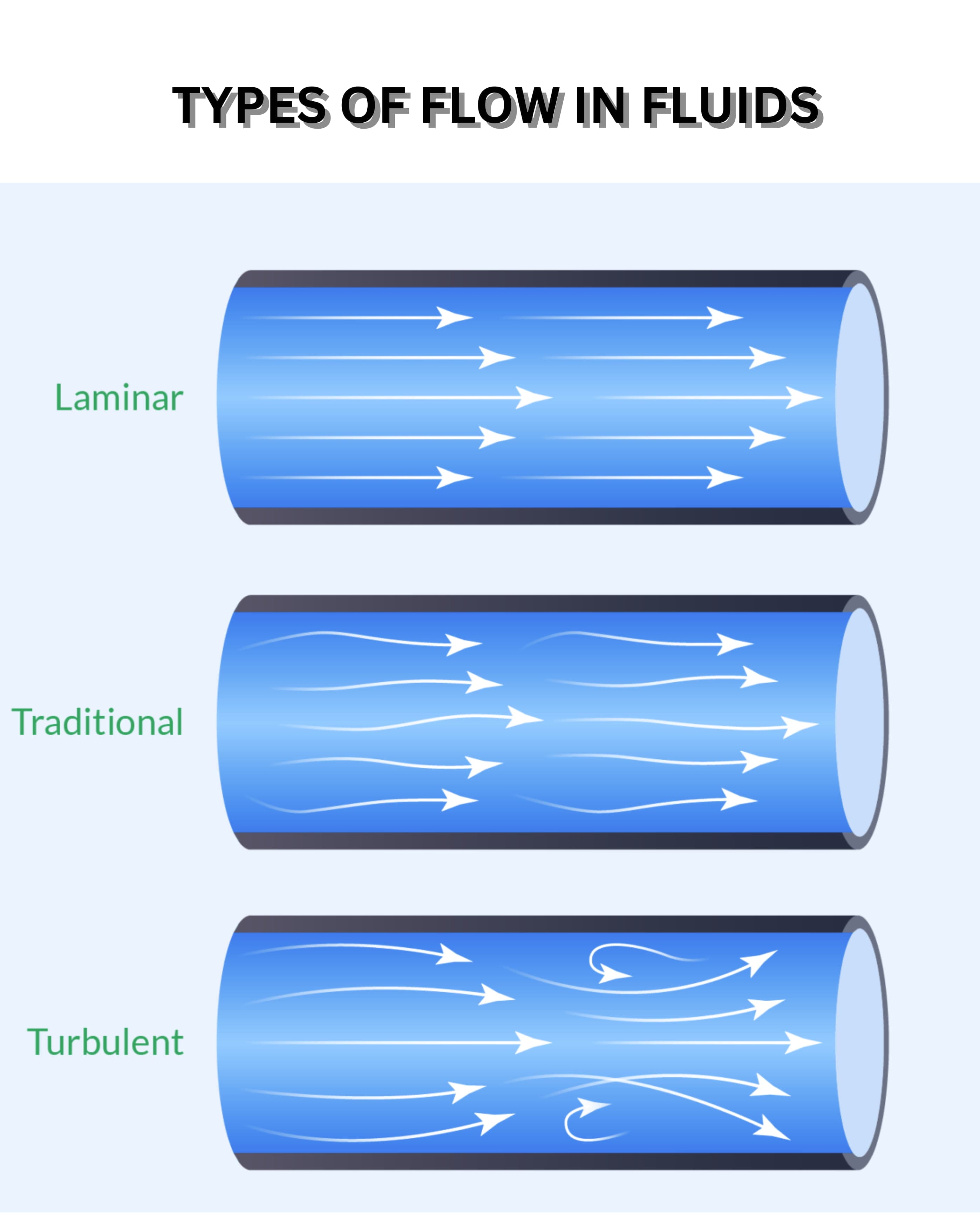
- Q26: Define Laminar or Streamline Flow.Ans: Laminar or streamline flow is the type of flow in which liquid particles move in smooth and parallel layers without mixing.
- Q27: Define Steady Flow.Ans: Steady flow is the type of flow in which the velocity, pressure and other properties do not change with time at a particular point.
- Q28: Define Unsteady Flow.Ans: Unsteady flow is the type of flow in which the velocity, pressure and other properties change with time at a particular point.
- Q29: Define Turbulent Flow.Ans: Turbulent flow is the type of flow in which liquid particles move in irregular paths and mix with each other. It usually occurs at high velocity.
- Q30: Define Rotational Flow.Ans: Rotational flow is the type of flow in which fluid particles rotate about their own axis while moving forward.
- Q31: Define Irrotational Flow.Ans: Irrotational flow is the type of flow in which fluid particles do not rotate about their own axis.
- Q32: Define Compressible Flow.Ans: Compressible flow is the type of flow in which the density of the fluid changes during motion. It is common in gases.
- Q33: Define In-Compressible Flow.Ans: Incompressible flow is the type of flow in which the density of the fluid remains constant during motion. It is common in liquids.
- Q34: Define One Dimensional Flow.Ans: One dimensional flow is the type of flow in which fluid properties vary only in one direction.
- Q35: Define Two Dimensional Flow.Ans: Two dimensional flow is the type of flow in which fluid properties vary in two directions.
- Q36: Define Three Dimensional Flow.Ans: Three dimensional flow is the type of flow in which fluid properties vary in all three directions.