HYDRAULIC VALVES AND SEALS
Other Chapters
INTRODUCTION TO HYDRAULICSHYDRO KINEMATICSFLOW THROUGH PIPESIMPACT OF JETWATER TURBINESPUMPSHYDRAULIC VALVES AND SEALSHYDRAULIC SIMPLE MACHINESHYDRAULIC ACTUATORSHYDRAULIC CIRCUITS AND ACCESSORIESPNEUMATIC SIMPLE MACHINES
- Q1: Define Valve.Ans: A valve is a mechanical device used to control the flow of fluid in a system. It can start, stop, or regulate the flow of liquid or gas.
- Q2: Define Hydraulic Valve.Ans: A hydraulic valve is a valve used in hydraulic systems to control the flow and pressure of hydraulic fluid. It ensures proper operation of hydraulic actuators and circuits.
- Q3: State the classification of Hydraulic Valves.Ans: Hydraulic valves are classified as:
- ➔ Pressure Control Valves
- ➔ Directional Control Valves
- ➔ Flow Control Valves
- ➔ Check Valves
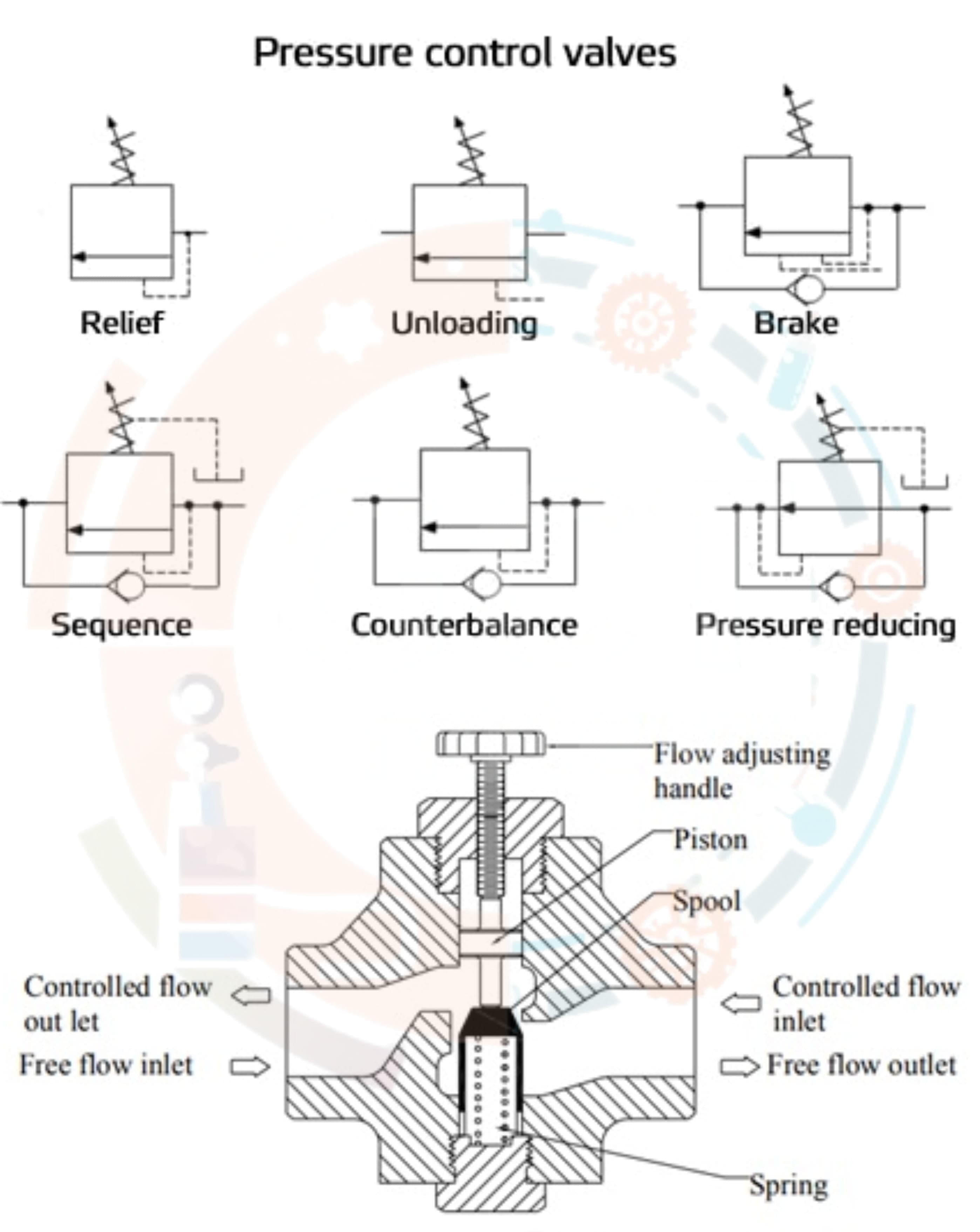
- Q4: What are Pressure Control Valves?Ans: Pressure control valves are hydraulic valves used to regulate or limit the pressure in a hydraulic system. They protect the system from overpressure and control the operation of actuators.
- Q5: Name the types of Pressure Control Valves.Ans: Types of pressure control valves include:
- ➔ Relief Valve
- ➔ Pressure Switch
- ➔ Pressure Reducing Valve
- ➔ Sequence Valve
- ➔ Counterbalance Valve
- Q6: Define Relief Valve.Ans: A relief valve is a safety valve that opens when system pressure exceeds a preset value to prevent damage. It allows excess fluid to flow back to the tank or reservoir.
- Q7: Define Simple Type Relief Valve.Ans: A simple type relief valve is a basic spring-loaded valve that opens when system pressure exceeds the spring setting and closes when pressure drops below the set value.
- Q8: Define Compound Type Relief Valve.Ans: A compound type relief valve has two or more springs or stages to provide more precise pressure control and higher capacity. It is used in systems with variable flow requirements.
- Q9: Define Pressure Switches.Ans: Pressure switches are devices that detect system pressure and activate electrical or mechanical signals when a preset pressure is reached. They are used for control and safety purposes.
- Q10: Define Pressure Reducing Valve.Ans: A pressure reducing valve automatically reduces the inlet pressure to a lower, controlled outlet pressure. It ensures that downstream components operate at safe pressure levels.
- Q11: Define Sequence Valve.Ans: A sequence valve is a pressure control valve that ensures hydraulic actuators operate in a predetermined order by opening only when a certain pressure is reached.
- Q12: Define Counterbalance Valve.Ans: A counterbalance valve is a pressure control valve that maintains a back pressure on a hydraulic cylinder to prevent it from running away or moving under load.
- Q13: What are Directional Control Valves?Ans: Directional control valves are hydraulic valves used to control the path or direction of fluid flow in a system. They determine which actuator or circuit receives fluid.
- Q14: Name the types of Directional Control Valves.Ans: Types of directional control valves include:
- ➔ 2/2 Directional Control Valve
- ➔ 3/2 Directional Control Valve
- ➔ 4/2 Directional Control Valve
- ➔ 4/3 Directional Control Valve
- Q15: Define 3/2 Directional Control Valve.Ans: A 3/2 directional control valve has three ports and two positions. It is commonly used to control single-acting cylinders by connecting the actuator to the pressure source or to the tank.
- Q16: Define Check Valve.Ans: A check valve is a type of valve that allows fluid to flow in one direction only and prevents backflow in a hydraulic system.
- Q17: Name the types of Check Valve.Ans: Types of check valves include:
- ➔ Standard Type Check Valve
- ➔ Right Angle Check Valve
- ➔ In Line Check Valve
- ➔ Restriction Type Check Valve
- ➔ Pilot Operated Check Valve
- Q18: Define Standard Type Check Valve.Ans: A standard type check valve allows fluid to flow straight through in one direction. It automatically closes when the flow reverses, preventing backflow.
- Q19: Define Right Angle Check Valve.Ans: A right angle check valve is designed with an inlet and outlet at 90 degrees to each other. It is used where piping layout requires a change in flow direction.
- Q20: Define In Line Check Valve.Ans: An in line check valve is installed directly in line with the pipeline and allows flow in one direction while closing automatically if flow reverses.
- Q21: State 4 uses of Check Valves.Ans: Uses of check valves include:
- ➔ Prevent backflow in pipelines.
- ➔ Protect pumps and compressors from damage due to reverse flow.
- ➔ Maintain pressure in a hydraulic system.
- ➔ Ensure one-way flow in single-acting cylinders.
- Q22: Define Restriction Type Check Valve.Ans: A restriction type check valve allows fluid to flow freely in one direction but restricts or throttles flow in the reverse direction. It is used for controlled backflow or cushioning.
- Q23: Define Pilot Operated Check Valve.Ans: A pilot operated check valve is a check valve that can be opened in the reverse direction by applying pressure through a pilot line. It is used in hydraulic circuits to control actuators while preventing backflow.
- Q24: Define Poppet Valve.Ans: A poppet valve is a type of valve that uses a disk or plug to control fluid flow. It opens and closes by lifting off its seat, allowing precise and fast control of flow.
- Q25: Define Sliding Spool Valve.Ans: A sliding spool valve is a directional control valve in which a cylindrical spool slides inside a sleeve or body to connect or block ports. It is widely used in hydraulic circuits for controlling actuators.
- Q26: Define Rotary Spool Valve.Ans: A rotary spool valve controls fluid flow by rotating a spool inside a cylindrical housing. It is used for smooth and compact flow control in hydraulic systems.
- Q27: Define Two Way Valve.Ans: A two way valve is a valve with two ports and two positions. It allows fluid to flow or stops it completely and is commonly used for on/off control.
- Q28: Define Four Way Valve.Ans: A four way valve is a directional control valve with four ports. It is mainly used to control double-acting cylinders by directing fluid to either side of the piston.
- Q29: Define Pilot Operated Four Way Valve.Ans: A pilot operated four way valve is a four way valve that uses hydraulic pilot pressure to shift the main spool. This allows remote or automatic control of actuators in a hydraulic circuit.
- Q30: What are Flow Control or Volume Control valves?Ans: Flow control or volume control valves are hydraulic valves used to regulate the flow rate of fluid in a system. By controlling the flow, they indirectly control the speed of actuators like hydraulic cylinders or motors.
- Q31: Name the types of Flow Control or Volume Control valves.Ans: Types of flow control or volume control valves include:
- ➔ Globe Valve
- ➔ Gate Valve
- ➔ Needle Valve
- ➔ Restricter
- ➔ Orifice Check Valve
- ➔ Flow Equalizer
- Q32: Define Globe Valve.Ans: A globe valve is a valve with a movable disk and a stationary seat. It is used to control the flow rate by adjusting the disk position, providing precise throttling of fluid.
- Q33: Define Gate Valve.Ans: A gate valve is a valve that uses a flat gate or wedge to start or stop fluid flow. It is mainly used for on/off control and provides minimal pressure drop when fully open.
- Q34: Define Needle Valve.Ans: A needle valve is a type of valve with a slender, pointed stem that fits into a conical seat. It allows very fine control of flow rate in hydraulic systems.
- Q35: Define Restricter.Ans: A restricter is a simple flow control device that reduces the flow rate by creating resistance in the path of the fluid. It is often used to limit speed or provide damping in a hydraulic circuit.
- Q36: Define Orifice Check Valve.Ans: An orifice check valve combines a check valve and a small orifice. It allows free flow in one direction but restricts flow in the reverse direction, providing controlled return of fluid.
- Q37: Define Flow Equalizer.Ans: A flow equalizer is a hydraulic device used to maintain equal flow rates in multiple branches of a circuit. It ensures synchronized operation of actuators connected in parallel.
- Q38: Define Hydraulic Seals.Ans: Hydraulic seals are devices used in hydraulic systems to prevent fluid leakage and maintain pressure. They are installed between moving or stationary components to ensure smooth and efficient operation.
- Q39: Name the types of Seals according to Function.Ans: Seals according to function are classified as:
- ➔ Dynamic Seals
- ➔ Static Seals
- Q40: Define Dynamic Seals.Ans: Dynamic seals are seals used where there is relative motion between surfaces, such as a piston moving in a cylinder. They prevent fluid leakage during movement.
- Q41: Define Static Seals.Ans: Static seals are seals used between stationary parts. They prevent leakage when parts are not moving, such as flanges or cover plates.
- Q42: Name the types of Seals according to Construction.Ans: Seals according to construction include:
- ➔ O-Rings
- ➔ Backup Rings
- ➔ T-Ring Seals
- ➔ Lathe Cut Seals
- ➔ Lip Seals
- ➔ Cup Seals
- ➔ Face Seals
- ➔ Piston Rings
- Q43: Define O-Rings.Ans: O-Rings are circular rings made of elastomeric material. They are placed in grooves to provide sealing under pressure in both static and dynamic applications.
- Q44: Define Backup Rings.Ans: Backup rings are non-elastic rings used with O-Rings to prevent extrusion and improve sealing at high pressures.
- Q45: Define T-Ring Seal.Ans: T-Ring seals have a T-shaped cross-section and provide enhanced sealing under high pressure with reduced friction. They are used in hydraulic cylinders and valves.
- Q46: Define Lathe Cut Seal.Ans: Lathe cut seals are flat ring seals cut from extruded material on a lathe. They are often used as static seals in hydraulic systems.
- Q47: Define Lip Seal.Ans: Lip seals have a flexible lip that maintains contact with a rotating shaft or surface to prevent fluid leakage. They are commonly used in hydraulic pumps and motors.
- Q48: Define Cup Seal.Ans: Cup seals have a cup-shaped profile and are used in cylinders to seal piston or rod surfaces. They maintain pressure and prevent fluid leakage.
- Q49: Define Face Seal.Ans: Face seals are flat seals placed between two mating faces. They prevent leakage by applying pressure to the contact surface and are used in flanges or valve covers.
- Q50: Define Piston Ring.Ans: Piston rings are circular seals mounted on a piston to prevent fluid from leaking past the piston in a cylinder. They ensure pressure is maintained for proper actuator operation.
- Q51: Name some Seal materials.Ans: Common seal materials include:
- ➔ Nitrile Rubber (NBR)
- ➔ Polyurethane (PU)
- ➔ PTFE (Teflon)
- ➔ Silicone Rubber
- ➔ Viton
- Q52: Name some safety devices used in Hydraulic Circuits.Ans: Safety devices in hydraulic circuits include:
- ➔ Relief Valves
- ➔ Pressure Switches
- ➔ Pressure Gauges
- ➔ Counterbalance Valves
- Q53: What are Hydraulic Circuits?Ans: Hydraulic circuits are arrangements of hydraulic components such as pumps, valves, actuators, and pipes. They direct the flow of hydraulic fluid to perform work like lifting, pushing, or rotating machinery.