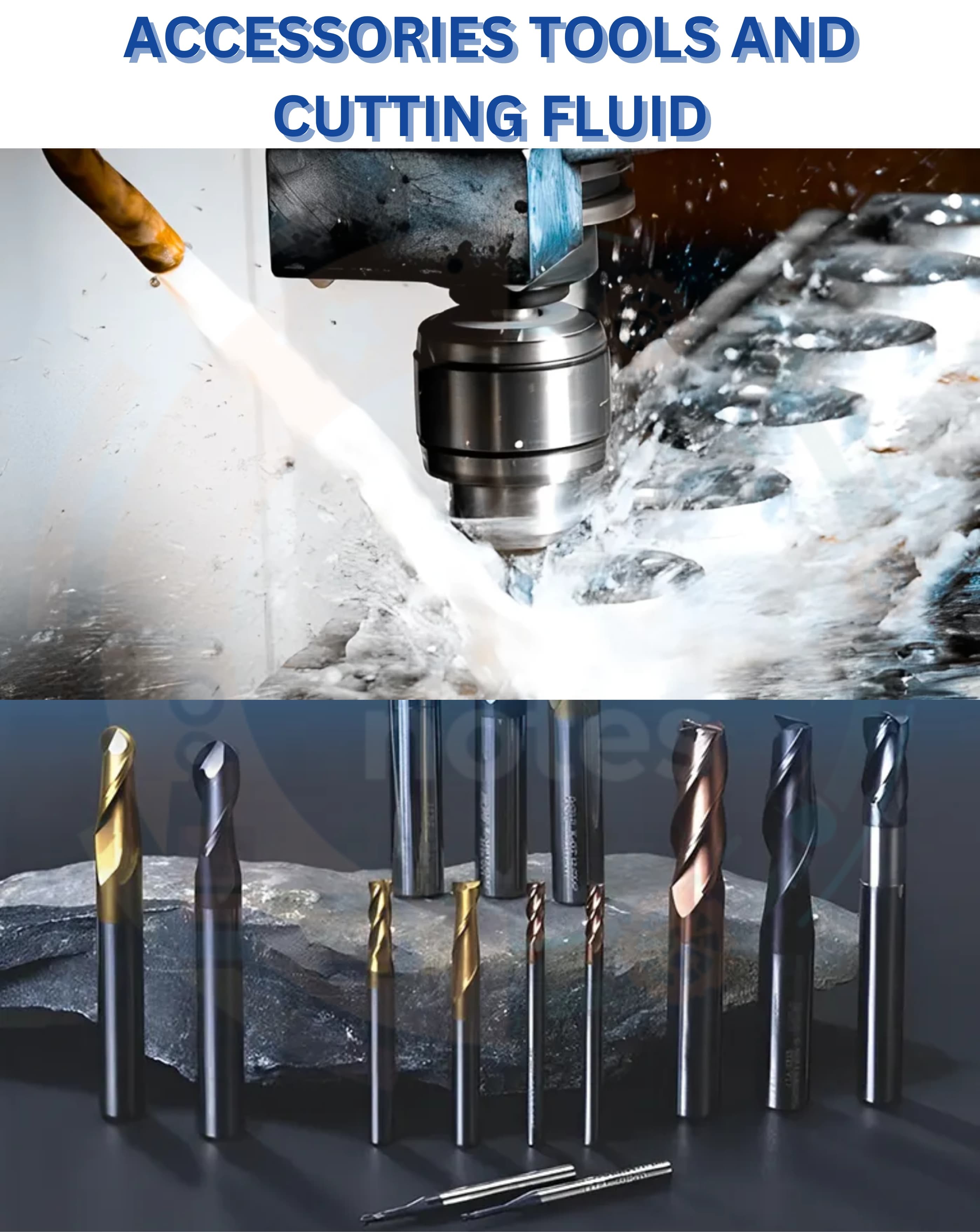
ACCESSORIES TOOLS AND CUTTING FLUID
Other Chapters
INTRODUCTION TO NUMERICAL CONTROLNC MACHINE TOOL CHARACTERISTICSTYPES OF MACHINE TOOLSCONFIGURATION AND CONTROL METHOD OF NC MACHINE TOOLSACCESSORIES TOOLS AND CUTTING FLUIDTURNING CENTER PROGRAMMACHINING CENTER PROGRAMAUTOMATED MANUFACTURING SYSTEMCONDITION FOR CUTTINGCUTTING TOOLS AND CHIPSSELECTING A TYPE OF TOOL MATERIAL
- Q1: Define Machine Center Accessories.Ans: Machine center accessories are additional devices used to improve the performance, accuracy, safety, and automation of a machine center.
- Q2: Name some Machine Center Accessories.Ans: Some of the Machine Center Accessories are as follows:
- ➔ Tool changer
- ➔ Chip conveyor
- ➔ Coolant system
- ➔ Tool magazine
- ➔ Call light
- Q3: Define HSK Spindle.Ans: HSK spindle is a hollow shank tool interface that provides high accuracy and rigidity at high spindle speeds.
- Q4: Define Tool Monitor.Ans: A tool monitor is a device used to detect tool breakage, wear, or overload during machining.
- Q5: Define Mist Controller.Ans: A mist controller removes oil mist from the machine enclosure to maintain a clean and safe working environment.
- Q6: Define MQL device.Ans: MQL device supplies a very small quantity of lubricant mixed with air for cooling and lubrication.
- Q7: Define Cutting Fluid Supply System.Ans: It is a system that delivers cutting fluid to the cutting zone for cooling and lubrication.
- Q8: Define Turret.Ans: A turret is a rotating tool holding device used to automatically change tools during machining.
- Q9: Define Simulation.Ans: Simulation is the virtual representation of machining operations used to detect errors before actual machining.
- Q10: Define SGI Control.Ans: SGI control is an advanced CNC control that improves surface finish by smoothening tool paths.
- Q11: Define Chip Conveyor.Ans: A chip conveyor is a device used to automatically remove chips from the machining area.
- Q12: Define Air Blow Device.Ans: An air blow device uses compressed air to remove chips and coolant from the work area.
- Q13: Define Jet Coolant.Ans: Jet coolant supplies cutting fluid at high pressure directly to the cutting zone.
- Q14: Define Mist Coolant.Ans: Mist coolant supplies coolant in atomized form mixed with air.
- Q15: Define Chuck Open/Close Confirmation Device.Ans: It is a safety device that confirms whether the chuck is properly opened or closed.
- Q16: Define Bar Puller.Ans: A bar puller is a device used to pull bar stock forward automatically in turning centers.
- Q17: Define Call Light.Ans: A call light provides visual indication of machine status using colored lights.
- Q18: Define Lubrication Pump.Ans: A lubrication pump supplies oil or grease to machine parts to reduce friction and wear.
- Q19: Define Drills.Ans: Drills are cutting tools used to produce circular holes in a workpiece.
- Q20: Name the types of Drills.Ans: The types of Drills are as follows:
- ➔ Twist drill
- ➔ Center drill
- ➔ Spade drill
- ➔ Carbide drill
- ➔ Carbide insert drill
- Q21: Define Twist Drill.Ans: A twist drill is a common drilling tool with helical flutes used for general drilling.
- Q22: Define Center Drill.Ans: A center drill is used to make a starting hole or center point before drilling.
- Q23: Define Spade Drill.Ans: A spade drill uses a flat blade and is suitable for large diameter holes.
- Q24: Define Carbide Drill.Ans: A carbide drill is made of carbide material and is used for high-speed and hard material drilling.
- Q25: Define Carbide Insert Drill.Ans: A carbide insert drill uses replaceable cutting inserts for drilling.
- Q26: Define Reamer.Ans: A reamer is a finishing tool used to improve the accuracy and surface finish of a drilled hole.
- Q27: Name some Turning Center Tools.Ans: Some of the Turning Center Tools are as follows:
- ➔ Turning tool
- ➔ Facing tool
- ➔ Grooving tool
- ➔ Boring tool
- ➔ Parting tool
- Q28: Define Turning Tool.Ans: A turning tool is used to remove material from the outer surface of a rotating workpiece.
- Q29: Define Grooving Tool.Ans: A grooving tool is used to cut narrow grooves on the workpiece.
- Q30: Define Facing Tool.Ans: A facing tool is used to produce a flat surface at the end of a workpiece.
- Q31: Define Boring Tool.Ans: A boring tool is used to enlarge and finish an existing hole.
- Q32: Define Parting Tool.Ans: A parting tool is used to cut off a finished component from the workpiece.
- Q33: Define Cutting Fluid.Ans: Cutting fluid is a liquid used to cool, lubricate, and remove chips during machining.
- Q34: Name the types of Cutting Fluid.Ans: The types of Cutting Fluid are as follows:
- ➔ Cutting oils
- ➔ Water soluble cutting oils
- Q35: Define Cutting Oils.Ans: Cutting oils are oil-based fluids used mainly for lubrication during machining.
- Q36: Name the types of Cutting Oils.Ans: The types of Cutting Oils are as follows:
- ➔ N1 type
- ➔ N2 type
- ➔ N3 type
- ➔ N4 type
- Q37: Define N1 Type Cutting Oils.Ans: N1 type cutting oils are light mineral oils used for low-speed machining.
- Q38: Define N2 Type Cutting Oils.Ans: N2 type cutting oils contain additives and are used for moderate machining operations.
- Q39: Define N3 Type Cutting Oils.Ans: N3 type cutting oils are heavy-duty oils used for severe cutting operations.
- Q40: Define N4 Type Cutting Oils.Ans: N4 type cutting oils contain extreme pressure additives for heavy-duty machining.
- Q41: Define Water Soluble Cutting Oils.Ans: Water soluble cutting oils are oils mixed with water to provide cooling and lubrication.
- Q42: Name the types of Water Soluble Cutting Oils.Ans: The types of Water Soluble Cutting Oils are as follows:
- ➔ A1 type
- ➔ A2 type
- ➔ A3 type
- Q43: Define A1 Type Water Soluble Cutting Oils.Ans: A1 type oils form milky emulsions and are used for general machining.
- Q44: Define A2 Type Water Soluble Cutting Oils.Ans: A2 type oils form translucent solutions and offer better cooling.
- Q45: Define A3 Type Water Soluble Cutting Oils.Ans: A3 type oils form clear solutions and provide excellent cooling.
- Q46: State some properties of good Cutting Fluids.Ans: Some of the properties are as follows:
- ➔ It has good cooling ability
- ➔ It has good lubrication
- ➔ It is Non-corrosive
- ➔ It is Non-toxic
- Q47: State some functions of good Cutting Fluids.Ans: Some of the functions are as follows:
- ➔ It reduces heat
- ➔ It reduces friction
- ➔ It improves tool life
- ➔ It improves surface finish
- Q48: What is SGI?Ans: SGI stands for Super Geometric Intelligence used to improve machining accuracy and surface finish.
- Q49: Write the functions of SGI.Ans: Some of the functions of SGI are as follows:
- ➔ Smoothens tool path
- ➔ Reduces vibration
- ➔ Improves surface finish
- ➔ Enhances accuracy
- Q50: Define RBU.Ans: RBU is a rotary buffer unit used for tool storage and transfer in machining centers.
- Q51: State the working of Automatic Tool Changer.Ans: The working of an Automatic Tool Changer can be understood step by step:
- ➔ The machine receives a command to change the tool.
- ➔ The spindle automatically stops to allow the tool change.
- ➔ The current tool is safely returned to the tool magazine.
- ➔ The new tool is selected from the magazine and loaded into the spindle.