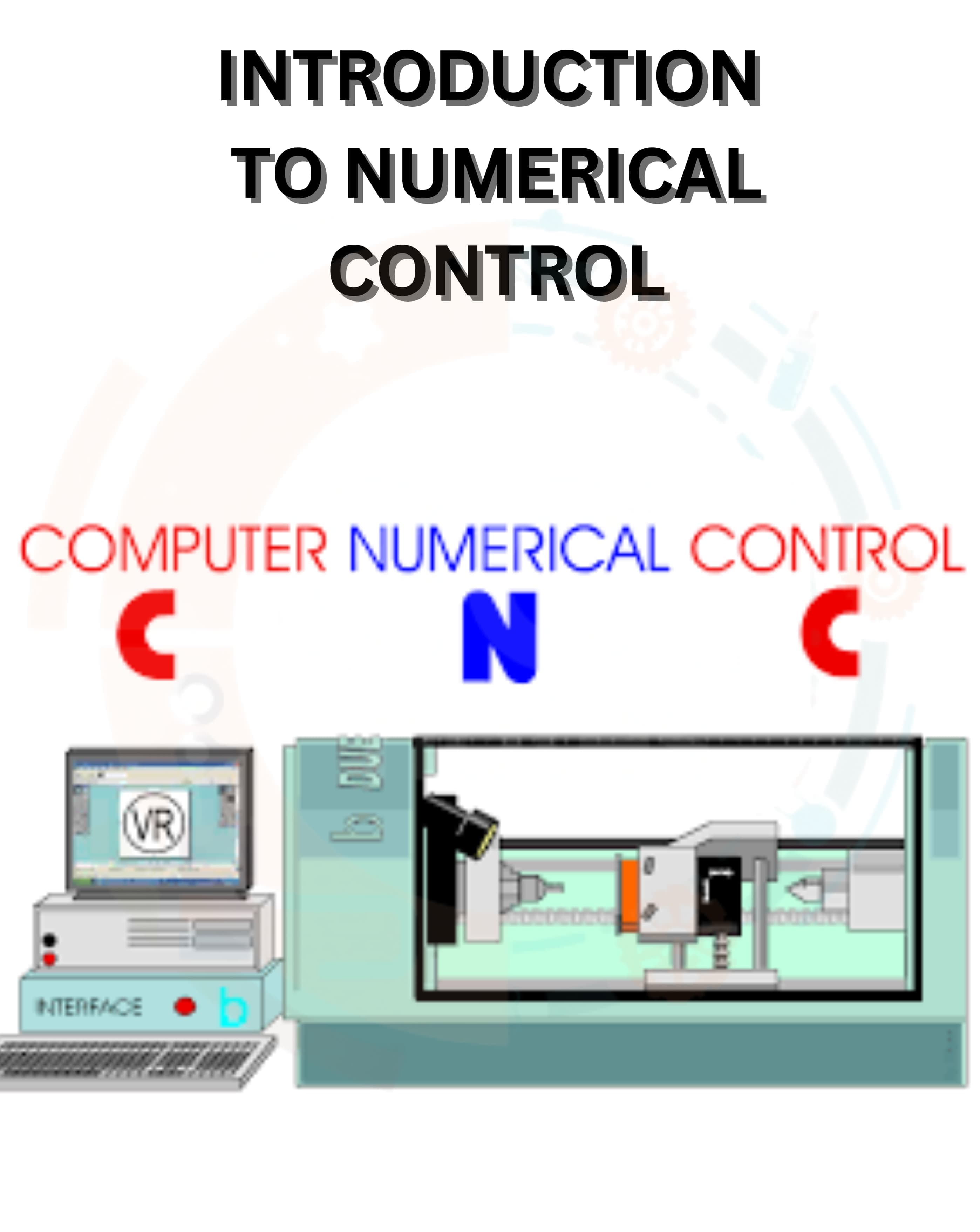
INTRODUCTION TO NUMERICAL CONTROL
Other Chapters
INTRODUCTION TO NUMERICAL CONTROLNC MACHINE TOOL CHARACTERISTICSTYPES OF MACHINE TOOLSCONFIGURATION AND CONTROL METHOD OF NC MACHINE TOOLSACCESSORIES TOOLS AND CUTTING FLUIDTURNING CENTER PROGRAMMACHINING CENTER PROGRAMAUTOMATED MANUFACTURING SYSTEMCONDITION FOR CUTTINGCUTTING TOOLS AND CHIPSSELECTING A TYPE OF TOOL MATERIAL
- Q1: What is a Numerical Control System (NC System)?Ans: A Numerical Control System is a manufacturing system in which machine operations are controlled by numerical instructions in the form of codes.
- Q2: What is the NC/CNC Program?Ans: An NC/CNC program is a set of coded instructions that tells the machine how to move tools and perform machining operations.
- Q3: Name the types of NC/CNC Programming.Ans: The types of NC/CNC programming are as followsare:
- ➔ Manual Programming
- ➔ Computer-Assisted Programming
- Q4: Write the types of Programming.Ans: The types of programming include:
- ➔ Absolute Programming
- ➔ Incremental Programming
- Q5: What are the components of a Numerical Control System?Ans: Main components of an NC system are as follows:
- ➔ Input device
- ➔ Controller
- ➔ Machine tool
- ➔ Feedback system
- Q6: Name the media of data storage.Ans: Data storage media are as follows:
- ➔ Paper tape
- ➔ Magnetic tape
- ➔ Disk drives
- ➔ Computer memory
- Q7: What is the purpose of Tape Reader?Ans: A tape reader reads the punched tape and sends the instructions to the controller.
- Q8: What is the purpose of Tape Punch?Ans: A tape punch is used to prepare or modify punched tapes by creating holes that represent instructions.
- Q9: What is the purpose of the Controller?Ans: The controller interprets program instructions and controls the movement of the machine tool.
- Q10: What is an NC Machine?Ans: An NC machine is a machine tool that operates automatically using numerical control instructions.
- Q11: What is MCU (Machine Control Unit)?Ans: MCU is the control unit that processes input data and controls machine movements.
- Q12: What is a Computer Numerical Control System (CNC System)?Ans: A CNC system is an advanced NC system where a computer is used to control machining operations.
- Q13: What is a Computer Numerical Control Machine (CNC Machine)?Ans: A CNC machine is a machine tool controlled by a computer using programmed instructions.
- Q14: Write the working of a CNC Machine.Ans: The working of a CNC machine is as follows:
- ➔ Program is entered into the computer
- ➔ Controller interprets the program
- ➔ Motors move the tool/workpiece
- ➔ Machining operation is performed
- Q15: Write the working of an NC Machine.Ans: The working of an NC machine is as follows:
- ➔ Program is prepared on punched tape
- ➔ Tape is read by tape reader
- ➔ Controller sends signals
- ➔ Machine performs operation
- Q16: Briefly state the history of Numerical Control.Ans: Numerical Control was developed in the 1950s to automate machine tools using punched tape systems.
- Q17: Name four advantages of Numerical Control System (NC System)?Ans: Some of the advantages of NC system are as follows:
- ➔ High accuracy
- ➔ Increased productivity
- ➔ Reduced human error
- ➔ Consistent quality
- Q18: Name four disadvantages of Numerical Control System (NC System)?Ans: Some of the disadvantages of NC system are as follows:
- ➔ High initial cost
- ➔ Complex maintenance
- ➔ Skilled operators required
- ➔ Limited flexibility
- Q19: Compare NC Machine and CNC Machine?Ans: Comparison between NC and CNC machines is as under:
- ➔ NC uses punched tape, CNC uses computer memory
- ➔ CNC is more flexible than NC
- ➔ CNC allows easy program editing
- Q20: List the operations of a Numerical Control Machine Tool?Ans: Operations include:
- ➔ Turning
- ➔ Drilling
- ➔ Milling
- ➔ Grinding
- Q21: Define Process Planning.Ans: Process planning is the systematic determination of manufacturing steps required to produce a part.
- Q22: Define Machining.Ans: Machining is a manufacturing process in which material is removed to shape a workpiece.
- Q23: Define Turning in Machine Operation.Ans: Turning is a machining operation where material is removed using a rotating workpiece.
- Q24: Define Taper Turning in Machine Operation.Ans: Taper turning produces a conical surface by gradually reducing the diameter of the workpiece.
- Q25: Define Contour Turning in Machine Operation.Ans: Contour turning produces curved or irregular shapes on a rotating workpiece.
- Q26: Name the factors controlling Turning in Machine Operation.Ans: Factors controlling turning are as follows:
- ➔ Cutting speed
- ➔ Feed rate
- ➔ Depth of cut
- Q27: Define Facing in Machine Operation.Ans: Facing is the operation of machining the flat surface at the end of a workpiece.
- Q28: Define Drilling in Machine Operation.Ans: Drilling is the operation of creating a circular hole using a rotating drill.
- Q29: Define Boring in Machine Operation.Ans: Boring enlarges an existing hole to improve accuracy and finish.
- Q30: Define Threading in Machine Operation.Ans: Threading is the process of cutting screw threads on a workpiece.
- Q31: Define Milling in Machine Operation.Ans: Milling removes material using a rotating multi-point cutting tool.
- Q32: Define Knurling in Machine Operation.Ans: Knurling creates a patterned surface for better grip.
- Q33: Define Parting in Machine Operation.Ans: Parting is the operation of cutting off a finished part from the workpiece.
- Q34: Define Grinding in Machine Operation.Ans: Grinding is a finishing process that uses an abrasive wheel to improve surface finish.
- Q35: Define Hobbing in Machine Operation.Ans: Hobbing is a machining process used to cut gear teeth.
- Q36: What is an APT Program?Ans: APT (Automatically Programmed Tool) is a high-level programming language used for NC machines.
- Q37: When was the APT Program developed?Ans: APT was developed in the late 1950s.
- Q38: What is Program Coding in NC Machine Tool Operation?Ans: Program coding is the process of converting machining instructions into numerical codes.
- Q39: What is a Process Sheet?Ans: A process sheet is a document that lists machining steps, tools, and parameters.
- Q40: What is Servomechanism?Ans: A servomechanism is a control system used to accurately control machine movement.
- Q41: What is an Encoder?Ans: An encoder is a feedback device that converts motion into electrical signals.
- Q42: What is a Controller?Ans: A controller is a device that manages and controls machine tool operations.
- Q43: What are Micro-computers?Ans: Micro-computers are small computers that use a microprocessor as the CPU.
- Q44: When were Micro-computers invented?Ans: Micro-computers were invented in the early 1970s.