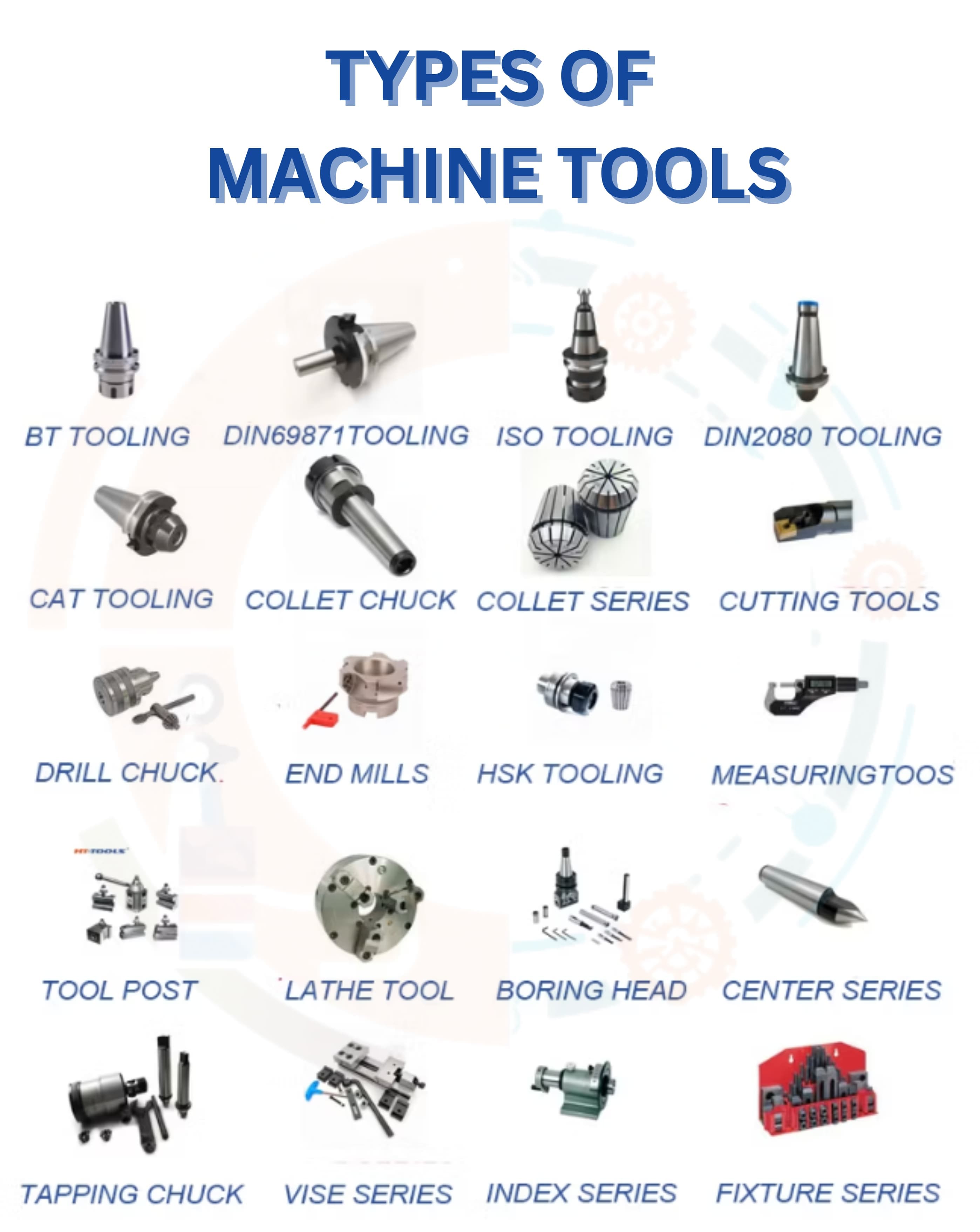
TYPES OF MACHINE TOOLS
Other Chapters
INTRODUCTION TO NUMERICAL CONTROLNC MACHINE TOOL CHARACTERISTICSTYPES OF MACHINE TOOLSCONFIGURATION AND CONTROL METHOD OF NC MACHINE TOOLSACCESSORIES TOOLS AND CUTTING FLUIDTURNING CENTER PROGRAMMACHINING CENTER PROGRAMAUTOMATED MANUFACTURING SYSTEMCONDITION FOR CUTTINGCUTTING TOOLS AND CHIPSSELECTING A TYPE OF TOOL MATERIAL
- Q1: Define Turning Center.Ans: A turning center is a CNC lathe that can perform multiple turning operations automatically with high accuracy.
- Q2: Name the types of Turning Center.Ans: Types of turning centers are:
- ➔ Horizontal Turning Center
- ➔ Vertical Turning Center
- ➔ Double Turret Turning Center
- ➔ Double Chuck Turning Center
- ➔ Universal Turning Center
- ➔ Turning Center with Milling Head Attachment
- Q3: What are the main parts of the Turning Center?Ans: The main parts of a turning center are as follows:
- ➔ Bed
- ➔ Headstock
- ➔ Chuck
- ➔ Tool turret
- ➔ Tailstock
- ➔ Control panel
- Q4: Define the Control Axis of the Turning Center.Ans: Control axes are the directions along which the tool or workpiece moves, usually X-axis and Z-axis.
- Q5: What is a Tool Turret?Ans: A tool turret is a rotating tool holder that automatically selects and holds cutting tools.
- Q6: What is a Tailstock?Ans: A tailstock supports the free end of the workpiece during machining.
- Q7: Define Horizontal Turning Center.Ans: A horizontal turning center has a horizontally mounted spindle and is commonly used for cylindrical parts.
- Q8: Define Vertical Turning Center.Ans: A vertical turning center has a vertically mounted spindle and is used for heavy and large-diameter components.
- Q9: Define Double Turret Turning Center.Ans: A double turret turning center uses two tool turrets to machine a part simultaneously, increasing productivity.
- Q10: Define Double Chuck Turning Center.Ans: A double chuck turning center has two chucks to machine two workpieces or both sides of a workpiece.
- Q11: Define Universal Turning Center.Ans: A universal turning center can perform both turning and limited milling operations.
- Q12: Define Turning Center with Milling Head Attachment.Ans: It is a turning center equipped with a milling head to perform milling along with turning.
- Q13: What is Rotary Axis?Ans: A rotary axis allows rotational movement of the tool or workpiece during machining.
- Q14: What is Chuck?Ans: A chuck is a device used to hold and rotate the workpiece in a turning center.
- Q15: Define Tailstock.Ans: A tailstock is used to support long workpieces and hold tools like drills.
- Q16: What is a Machining Center?Ans: A machining center is a CNC machine capable of performing milling, drilling, boring, and tapping operations.
- Q17: Name the types of Machining Center.Ans: The types of machining centers are as follows:
- ➔ Vertical Machining Center
- ➔ Horizontal Machining Center
- ➔ Double Housing Machining Center
- Q18: Define Horizontal Machining Center.Ans: A horizontal machining center has a horizontal spindle and is suitable for heavy-duty machining.
- Q19: Define Vertical Machining Center.Ans: A vertical machining center has a vertically oriented spindle and is widely used for general machining.
- Q20: Define Double Housing Machining Center.Ans: A double housing machining center has two vertical columns for high rigidity and accuracy.
- Q21: Define Saddle.Ans: A saddle is a supporting structure that allows movement of the table or tool along an axis.
- Q22: Define ATC (Automatic Tool Changer).Ans: ATC is a mechanism that automatically changes cutting tools during machining.
- Q23: Define Knee Type Milling Machine.Ans: A knee type milling machine has an adjustable knee that supports the table.
- Q24: Define Bed Type Milling Machine.Ans: A bed type milling machine has a fixed bed and the table moves along the axes.
- Q25: State some operations of the NC Milling Machine.Ans: The operations of NC milling machine are as follows:
- ➔ Face milling
- ➔ End milling
- ➔ Slot cutting
- ➔ Gear cutting
- ➔ Keyway cutting
- Q26: Define Face Milling.Ans: Face milling produces a flat surface using a rotating cutting tool.
- Q27: Define End Milling.Ans: End milling removes material using the end and sides of the cutter.
- Q28: Define Dovetail Cutting.Ans: Dovetail cutting produces dovetail-shaped slots used in machine slides.
- Q29: Define Gear Cutting.Ans: Gear cutting is the process of machining teeth on a gear blank.
- Q30: Define Keyway Cutting.Ans: Keyway cutting creates a slot in a shaft to hold a key.
- Q31: Define Jig-Boring.Ans: Jig-boring is a precise machining process used to locate and enlarge holes accurately.
- Q32: Define NC Hobbing Machine.Ans: An NC hobbing machine is used to manufacture gears using numerical control.
- Q33: Name the gears manufactured by NC Hobbing Machine.Ans: The gears manufactured by NC hobbing machine are as follows:
- ➔ Spur gears
- ➔ Helical gears
- ➔ Worm gears
- ➔ Sprockets
- Q34: Define NC Grinder.Ans: An NC grinder is a grinding machine controlled by numerical instructions to achieve high precision and surface finish.
- Q35: Name the types of NC Grinder.Ans: The types of NC grinders are as follows:
- ➔ Surface Grinder
- ➔ Cylindrical Grinder
- ➔ CAM Grinder
- ➔ Tool Grinder
- Q36: Define Surface Grinder.Ans: A surface grinder is used to produce a smooth and flat surface on a workpiece.
- Q37: Define CAM Grinder.Ans: A CAM grinder is used to grind cam profiles accurately.
- Q38: Define Cylindrical Grinder.Ans: A cylindrical grinder is used to grind the external or internal cylindrical surfaces of a workpiece.
- Q39: What is NC Tool Grinder?Ans: An NC tool grinder is used to sharpen and manufacture cutting tools with high accuracy.
- Q40: Define Flute Angle.Ans: Flute angle is the angle between the flute and the axis of a cutting tool.
- Q41: Define Relief Angle.Ans: Relief angle is the angle that prevents the tool from rubbing against the workpiece.
- Q42: Define Clearance Angle.Ans: Clearance angle is the angle provided below the cutting edge to reduce friction.
- Q43: Define NC Laser Machine Tool.Ans: An NC laser machine tool uses a laser beam controlled by numerical commands to cut or shape materials.
- Q44: Name the types of Lasers.Ans: The types of lasers are as follows:
- ➔ CO₂ Laser
- ➔ Nd:YAG Laser
- ➔ Fiber Laser
- ➔ Ruby Laser
- Q45: Define Laser Processes.Ans: Laser processes include:
- ➔ Laser cutting
- ➔ Laser drilling
- ➔ Laser welding
- ➔ Laser marking
- Q46: Name four advantages of Laser Machines.Ans: Some of the advantages of laser machines are as follows:
- ➔ High precision
- ➔ No tool wear
- ➔ High cutting speed
- ➔ Clean and accurate cuts
- Q47: Name four disadvantages of Laser Machines.Ans: Some of the disadvantages of laser machines are as follows:
- ➔ High initial cost
- ➔ High power consumption
- ➔ Limited thickness cutting
- ➔ Safety concerns
- Q48: Define EDM (Electric Discharge Machining).Ans: EDM is a machining process that removes material using electrical sparks.
- Q49: Name the types of EDM.Ans: Types of EDM are:
- ➔ Die-sinking EDM
- ➔ Wire Cut EDM
- Q50: Define Wire Cut Electric Discharge Machine.Ans: Wire cut EDM uses a thin wire electrode to cut complex shapes using electric sparks.
- Q51: Name the types of Wire Cut Electric Discharge Machine.Ans: Types of wire cut EDM are:
- ➔ CNC Wire Cut EDM
- ➔ NC Wire Cut EDM
- Q52: Define Die-Sinking Electric Discharge Machine.Ans: Die-sinking EDM removes material by spark erosion using a shaped electrode.
- Q53: Define EDM Electrodes Tools.Ans: EDM electrode tools are conductive materials used to generate sparks for machining.
- Q54: Define Dielectric Fluids.Ans: Dielectric fluids are insulating liquids used in EDM to control sparks and remove debris.
- Q55: Name the main parts of the Electric Discharge Machine.Ans: The main parts of EDM are as follows:
- ➔ Power supply
- ➔ Electrode tool
- ➔ Workpiece
- ➔ Dielectric fluid system
- ➔ Control unit
- Q56: Name four advantages of Electric Discharge Machine.Ans: Some of the advantages of EDM are as follows:
- ➔ Can machine hard materials
- ➔ No cutting force
- ➔ High accuracy
- ➔ Complex shapes possible
- Q57: Name four disadvantages of Electric Discharge Machine.Ans: Some of the disadvantages of EDM are as follows:
- ➔ Slow machining rate
- ➔ High power consumption
- ➔ Electrode wear
- ➔ Limited to conductive materials
- Q58: What does LASER stand for?Ans: LASER stands for Light Amplification by Stimulated Emission of Radiation.
- Q59: Why is the cut in the CNC Grinding Machine kept very slow?Ans: To avoid overheating and to achieve high accuracy and surface finish.
- Q60: Briefly write the working of Die-sinking Electric Discharge Machine.Ans: The working of die-sinking EDM is as follows:
- ➔ Electrode and workpiece are submerged in dielectric fluid
- ➔ Electric sparks remove material
- ➔ Shape of electrode is reproduced on workpiece
- Q61: Briefly write the working of Wire Cut Electric Discharge Machine.Ans: The working of a Wire Cut EDM can be explained step by step:
- ➔ A thin wire acts as the electrode and is positioned close to the workpiece.
- ➔ Controlled electrical sparks are generated between the wire and the workpiece, cutting the material precisely.
- ➔ The wire is continuously fed from a spool to maintain a constant cutting process.
- Q62: What is a Driven Tool?Ans: A driven tool is a rotating tool powered by the machine spindle for milling or drilling.
- Q63: State the working principle of the Hobbing Machine.Ans: Hobbing works on the principle of continuous relative motion between the hob and the workpiece.
- Q64: What kind of metals can be cut on an NC Die-sinking Electric Discharge Machine?Ans: Only electrically conductive metals can be machined.
- Q65: What will happen if the wire touches the work-piece during operation in Wire Cut EDM?Ans: The wire will break due to short circuit.
- Q66: What is the voltage consumption of an Electric Discharge Machine?Ans: An Electric Discharge Machine generally operates at a low voltage range of about 60 to 300 volts.