REFRIGERATION AND AIR CONDITIONING
Other Chapters
FUNDAMENTALS OF THERMODYNAMICSLAWS AND PROPERTIES OF PERFECT GASESTHERMODYNAMIC PROCESS AND CYCLESFORMATION AND PROPERTIES OF STEAMSTEAM BOILERS AND PERFORMANCESTEAM AND GAS TURBINEINTERNAL COMBUSTION ENGINESAIR COMPRESSORS AND THEIR PERFORMANCEREFRIGERATION AND AIR CONDITIONING
- Q1: Define Refrigeration.Ans: Refrigeration is the process of removing heat from a space or substance to lower its temperature and keep it cool.
- Q2: Define Refrigerant.Ans: A refrigerant is a working fluid used in a refrigeration system that absorbs heat from a low temperature area and releases it at a high temperature area.
- Q3: Name any four Refrigerants.Ans: Some common refrigerants are:
- ➔ Ammonia (NH3)
- ➔ Carbon dioxide (CO2)
- ➔ R-134a
- ➔ R-22
- Q4: Write some properties of a good refrigerant.Ans: Properties of a good refrigerant are:
- ➔ Low boiling point
- ➔ High latent heat
- ➔ Non-toxic
- ➔ Non-flammable
- ➔ Non-corrosive
- ➔ Low cost and easily available
- Q5: Define Air Conditioning.Ans: Air conditioning is the process of controlling temperature, humidity, cleanliness, and air movement in a closed space to provide comfort.
- Q6: What is an Air Conditioner?Ans: An air conditioner is a machine that cools and controls the air inside a room or building.
- Q7: Write the classification of Air Conditioning systems.Ans: Air Conditioning systems are classified as follows:
- ➔ According to Purpose
- • Comfort Air Conditioning System
- • Industrial Air Conditioning System
- ➔ According to Season
- • Winter Air Conditioning System
- • Summer Air Conditioning System
- • Year Round Air Conditioning System
- ➔ According to the arrangement of Equipment
- • Unitary Air Conditioning System
- • Central Air Conditioning System
- ➔ According to Purpose
- Q8: Write the classification of Refrigeration systems.Ans: Refrigeration systems are classified as:
- ➔ Vapour Compression System
- ➔ Vapour Absorption System
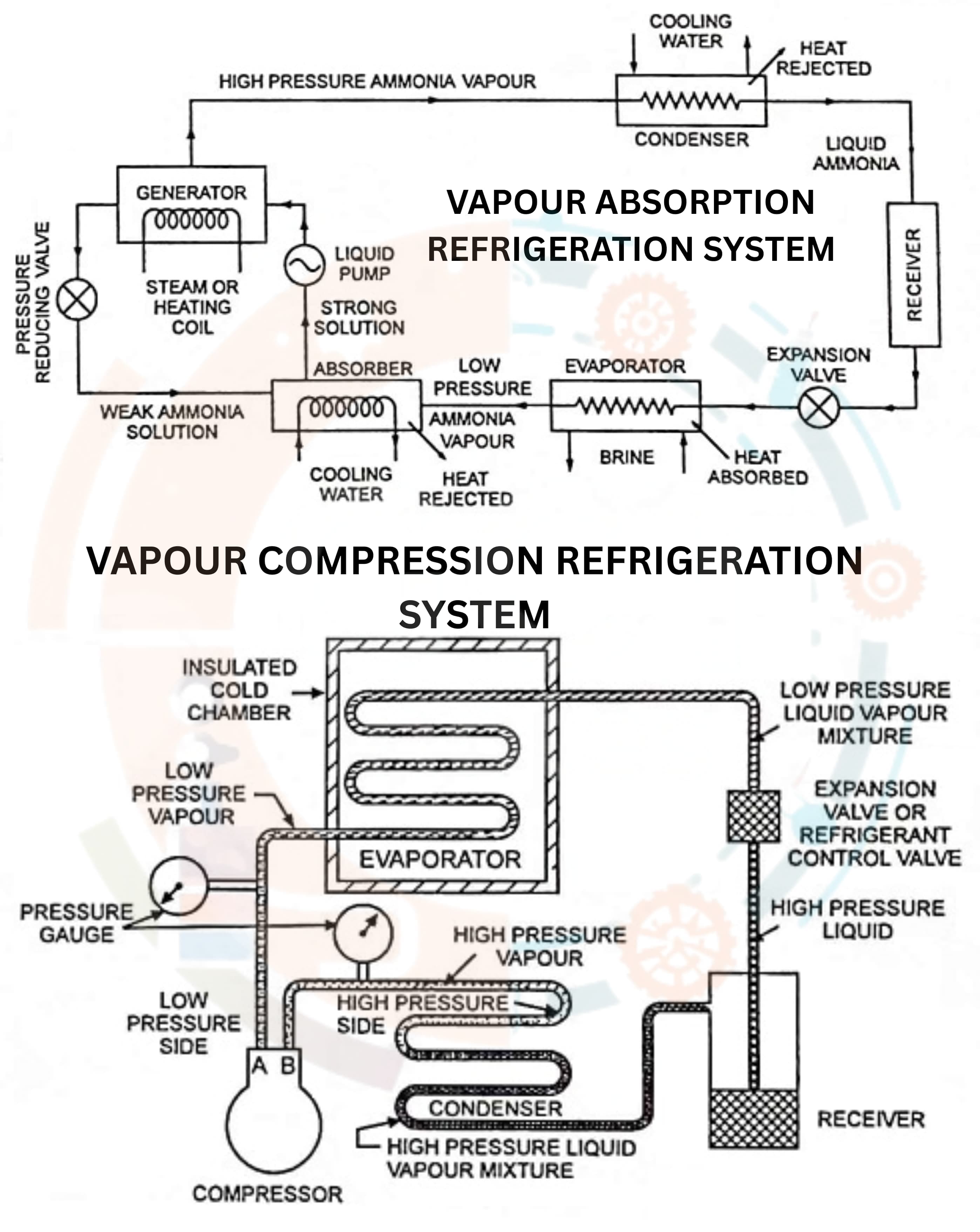
- Q9: Briefly explain Vapour Compression System.Ans: In a vapour compression system, the refrigerant is compressed, condensed, expanded, and evaporated to remove heat from the desired space.
- Q10: What is Brine?Ans: Brine is a salt solution used as a secondary refrigerant to carry cooling effect from the evaporator to the space.
- Q11: Write the use of Vapour Compression System.Ans: Vapour compression system is used in refrigerators, air conditioners, and cold storage plants for cooling purposes.
- Q12: Briefly explain Vapour Absorption System.Ans: In a vapour absorption system, heat energy is used to circulate the refrigerant instead of a mechanical compressor.
- Q13: Write the use of Expansion Valve in Vapour Absorption System.Ans: The expansion valve reduces the pressure of the refrigerant and controls its flow into the evaporator.
- Q14: Write the use of Absorber in Vapour Absorption System.Ans: The absorber absorbs refrigerant vapour into the absorbent and helps maintain low pressure in the evaporator.
- Q15: Write the use of Vapour Absorption System.Ans: Vapour absorption system is used where waste heat or steam is available for refrigeration.
- Q16: Name some technical terms used for Refrigeration and Air Conditioning.Ans: Some technical terms are:
- ➔ Refrigeration Effect
- ➔ Latent Heat
- ➔ Sensible Heat
- ➔ COP (Coefficient of Performance)
- ➔ Ton of Refrigeration
- Q17: What is the unit of Refrigeration?Ans: The unit of refrigeration is Ton of Refrigeration (TR).
- Q18: Define Tonne of Refrigeration.Ans: One tonne of refrigeration is the amount of heat removed to freeze one tonne of water into ice at 0°C in 24 hours.
- Q19: What is the Latent Heat of Ice?Ans: Latent heat of ice is the amount of heat required to change water into ice at 0°C without change in temperature.
- Q20: Define Coefficient of Performance.Ans: Coefficient of Performance (COP) is the ratio of refrigeration effect to the work input given to the system.
- Q21: Define Efficiency of Heat Engine.Ans: Efficiency of a heat engine is the ratio of work output to the heat supplied to the engine.
- Q22: Define Relative Coefficient of Performance.Ans: Relative COP is the ratio of actual COP to the maximum possible COP.
- Q23: What is a Heat Engine?Ans: A heat engine is a machine that converts heat energy into mechanical work.
- Q24: Write the formula for Work Done of a Heat Engine.Ans: Work Done = Heat Supplied — Heat Rejected.
- Q25: Define Atmospheric Temperature.Ans: Atmospheric temperature is the temperature of the surrounding air in the atmosphere.
- Q26: Define Heat Pump.Ans: A heat pump is a device that transfers heat from a low temperature area to a high temperature area.
- Q27: Can a refrigerator be called a heat pump?.Ans: Yes, a refrigerator can be called a heat pump because it transfers heat from a low temperature region to a high temperature region.
- Q28: Define Coefficient of Performance of a Heat Pump.Ans: COP of a heat pump is the ratio of heat supplied to the hot body to the work done on compressor.
- Q29: Define Dry Air.Ans: Dry air is air that does not contain water vapour. Normally Dry Air is not found as air contains water vapours to some extent
- Q30: What is the Molecular mass of air?Ans: The molecular mass of air is approximately 28.97 kg/kmol.
- Q31: What is the Density of Dry Air?Ans: The density of dry air is the mass of air per unit volume. At standard atmospheric conditions (0°C and 1 atm pressure), the density of dry air is approximately 1.29 kg/m³. It changes with temperature and pressure.
- Q32: Define Saturated Air.Ans: Saturated air is the air that contains the maximum amount of water vapour at a given temperature. At this condition, the air cannot hold any more moisture and condensation may start.
- Q33: Define Humidity.Ans: Humidity is the amount of water vapour present in the air. It indicates how much moisture is mixed with dry air in the atmosphere.
- Q34: Define Specific Humidity.Ans: Specific humidity is the ratio of the mass of water vapour to the total mass of moist air. It is usually expressed in kg of water vapour per kg of moist air.
- Q35: Define Relative Humidity.Ans: Relative humidity is the ratio of the actual amount of water vapour present in air to the maximum amount the air can hold at the same temperature. It is expressed in percentage.
- Q36: Define Absolute Humidity.Ans: Absolute humidity is the actual mass of water vapour present in a unit volume of air. It is usually expressed in kg per cubic meter of air.
- Q37: Define Temperature.Ans: Temperature is the measure of the degree of hotness or coldness of a body. It indicates the average kinetic energy of the molecules in a substance.
- Q38: Define Dry Bulb Temperature.Ans: Dry bulb temperature is the temperature of air measured by a normal thermometer freely exposed to air but shielded from radiation and moisture.
- Q39: Define Wet Bulb Temperature.Ans: Wet bulb temperature is the temperature measured by a thermometer whose bulb is covered with a wet cloth and exposed to air. It indicates the effect of evaporation and humidity in air.
- Q40: Define Wet Bulb Depression.Ans: Wet bulb depression is the difference between dry bulb temperature and wet bulb temperature. It shows the dryness of air.
- Q41: Define Dew Point Temperature.Ans: Dew point temperature is the temperature at which air becomes saturated and water vapour starts to condense into liquid when cooled at constant pressure.
- Q42: Define Dew Point Depression.Ans: Dew point depression is the difference between the dry bulb temperature and the dew point temperature of air.
- Q43: Define Sensible Heat.Ans: Sensible heat is the heat added or removed from a substance that causes a change in temperature without changing its physical state.
- Q44: Define Latent Heat.Ans: Latent heat is the heat added or removed from a substance that causes a change in its physical state without changing its temperature.
- Q45: What is R-134a?Ans: R-134a (Tetrafluoroethane) is a halo-carbon refrigerant commonly used in refrigerators and automobile air conditioning systems. It is a non-ozone depleting refrigerant and belongs to the HFC group.
- Q46: What is R-40?Ans: R-40 is methyl chloride used as a refrigerant in early refrigeration systems. It is rarely used today because it is toxic and flammable.
- Q47: Define ASHRAE.Ans: ASHRAE stands for American Society of Heating, Refrigerating and Air-Conditioning Engineers. It is an international organization that develops standards and guidelines for HVAC and refrigeration systems.
- Q48: Define Halo-carbon Refrigerants.Ans: Halo-carbon refrigerants are refrigerants made from hydrocarbons in which hydrogen atoms are replaced by halogen elements like chlorine, fluorine, or bromine.
- Q49: Name four Halo-carbon Refrigerants.Ans: Four Halo-carbon refrigerants are:
- ➔ R-11
- ➔ R-12
- ➔ R-22
- ➔ R-134a
- Q50: Define Azeotrope Refrigerants.Ans: Azeotrope refrigerants are mixtures of two or more refrigerants that behave like a single substance and boil at a constant temperature.
- Q51: Name four Azeotrope Refrigerants.Ans: Four Azeotrope refrigerants are:
- ➔ R-500
- ➔ R-502
- ➔ R-503
- ➔ R-507
- Q52: Define Inorganic Refrigerants.Ans: Inorganic refrigerants are refrigerants that do not contain carbon and are obtained from natural sources.
- Q53: Name four Inorganic Refrigerants.Ans: Four inorganic refrigerants are:
- ➔ Ammonia (R-717)
- ➔ Carbon Dioxide (R-744)
- ➔ Water (R-718)
- ➔ Air (R-729)
- Q54: Define Hydro Carbon Refrigerants.Ans: Hydrocarbon refrigerants are refrigerants made only of hydrogen and carbon atoms. They are natural refrigerants and are environmentally friendly but flammable.
- Q55: Name four Define Hydro Carbon Refrigerants.Ans: Four Hydrocarbon refrigerants are:
- ➔ R-290 (Propane)
- ➔ R-600 (Butane)
- ➔ R-600a (Isobutane)
- ➔ R-1270 (Propylene)
- Q56: What is R-717?Ans: R-717 is ammonia used as a refrigerant. It is widely used in industrial refrigeration because of its high efficiency and low cost.
- Q57: Write two uses of R-717.Ans: Two uses of R-717 are:
- ➔ Used in cold storage plants
- ➔ Used in ice manufacturing plants
- Q58: Write some properties of Ammonia.Ans: Some properties of Ammonia are:
- ➔ High latent heat
- ➔ Pungent smell
- ➔ Toxic in high concentration
- ➔ Environment friendly (no ozone depletion)
- Q59: What is R-744?Ans: R-744 is carbon dioxide used as a refrigerant. It is a natural refrigerant with low environmental impact.
- Q60: Write two uses of R-744.Ans: Two uses of R-744 are:
- ➔ Used in supermarket refrigeration systems
- ➔ Used in beverage cooling systems
- Q61: Write some properties of Carbon Dioxide.Ans: Some properties of Carbon Dioxide are:
- ➔ Non-flammable
- ➔ Non-toxic in low concentration
- ➔ High operating pressure
- ➔ Environment friendly refrigerant
- Q62: What is R-764?Ans: R-764 is sulphur dioxide used as a refrigerant in early refrigeration systems. It was mainly used in domestic refrigerators before safer refrigerants were developed.
- Q63: Write two uses of R-764.Ans: Two uses of R-764 are:
- ➔ Used in early domestic refrigerators
- ➔ Used in small cooling plants in old systems
- Q64: Write some properties of Sulphur Dioxide.Ans: Some properties of Sulphur Dioxide are:
- ➔ Colorless gas with strong smell
- ➔ Toxic in nature
- ➔ Non-flammable
- ➔ Corrosive to metals in presence of moisture
- Q65: What is R-12, Freon-12?Ans: R-12, also known as Freon-12, is a halo-carbon refrigerant belonging to the CFC group. It was widely used in refrigerators and air conditioners because of its stability and safety.
- Q66: Write two uses of R-12, Freon-12.Ans: Two uses of R-12 are:
- ➔ Used in domestic refrigerators
- ➔ Used in automobile air conditioning systems
- Q67: Write some properties of Freon-12.Ans: Some properties of Freon-12 are:
- ➔ Non-toxic and non-flammable
- ➔ Chemically stable
- ➔ Non-corrosive
- ➔ Good dielectric strength
- Q68: Why is Freon-12 not used nowadays?Ans: Freon-12 is not used nowadays because it is a CFC refrigerant that damages the ozone layer and contributes to global warming. Due to environmental regulations, it has been replaced by eco-friendly refrigerants.
- Q69: What is R-134a?Ans: R-134a is a hydrofluorocarbon (HFC) refrigerant used as a replacement for R-12. It does not damage the ozone layer and is commonly used in modern refrigeration systems.
- Q70: Write two uses of R-134a.Ans: Two uses of R-134a are:
- ➔ Used in domestic refrigerators
- ➔ Used in car air conditioning systems
- Q71: Write some properties of R-134a.Ans: Some properties of R-134a are:
- ➔ Non-ozone depleting refrigerant
- ➔ Non-flammable
- ➔ Chemically stable
- ➔ Good thermodynamic properties
- Q72: Briefly explain the mechanism of a Vapour Compression Refrigeration System.Ans: In a vapour compression refrigeration system, the refrigerant is compressed by the compressor, then cooled and condensed in the condenser. It passes through the expansion valve where pressure is reduced, and finally absorbs heat in the evaporator to produce cooling. This cycle repeats continuously.
- Q73: Name the parts of Vapour Compression Refrigeration System.Ans: The main parts are:
- ➔ Compressor
- ➔ Condenser
- ➔ Receiver
- ➔ Expansion Valve
- ➔ Evaporator
- Q74: Define Compressor.Ans: A compressor is a device that increases the pressure and temperature of the refrigerant vapour and circulates it through the system.
- Q75: Define Condenser.Ans: A condenser is a heat exchanger where high-pressure refrigerant vapour releases heat to the surroundings and changes into liquid.
- Q76: Define Receiver.Ans: A receiver is a storage tank used to store liquid refrigerant after condensation and supply it to the expansion valve.
- Q77: Define Expansion Valve.Ans: An expansion valve is a device that reduces the pressure and temperature of the liquid refrigerant before it enters the evaporator.
- Q78: Define Throttle Valve.Ans: A throttle valve is a device used to control the flow of refrigerant and reduce its pressure suddenly without doing external work.
- Q79: Define Evaporator.Ans: An evaporator is a heat exchanger where the refrigerant absorbs heat from the space to be cooled and changes from liquid to vapour.
- Q80: What are the fundamentals of Air Conditioning Systems?Ans: The fundamentals of air conditioning systems are:
- ➔ Control of temperature
- ➔ Control of humidity
- ➔ Purity of air
- ➔ Proper motion of air
- Q81: Define Purity of Air.Ans: Purity of air means supplying clean air free from dust, smoke, germs, and other harmful impurities.
- Q82: Define Motion of Air.Ans: Motion of air refers to the proper circulation and distribution of air inside a conditioned space to maintain uniform comfort.
- Q83: Name the basic elements of the Air Conditioning System.Ans: The basic elements are:
- ➔ Fan
- ➔ Filter
- ➔ Coils
- ➔ Refrigeration Plant
- ➔ Control System
- Q84: Define Humidification.Ans: Humidification is the process of adding moisture to air to increase its humidity level.
- Q85: Define De-humidification.Ans: De-humidification is the process of removing excess moisture from air to reduce its humidity level.
- Q86: Define Humidifier.Ans: A humidifier is a device used to add moisture to air in order to increase humidity.
- Q87: Define De-humidifier.Ans: A de-humidifier is a device used to remove moisture from air and control humidity.
- Q88: Define Comfort Air Conditioning System.Ans: Comfort air conditioning system is designed to provide comfortable environmental conditions for human beings in homes, offices, and public buildings.
- Q89: Define Industrial Air Conditioning System.Ans: Industrial air conditioning system is used in industries to control temperature, humidity, and air purity for manufacturing processes and product quality.
- Q90: Define Winter Air Conditioning System.Ans: Winter air conditioning system is a system used during winter season to maintain comfort conditions. It mainly heats the air and may also humidify it to maintain proper temperature and moisture level inside the room.
- Q91: Define Summer Air Conditioning System.Ans: Summer air conditioning system is used during summer season to provide cooling. It removes heat and excess moisture from the air to maintain comfortable temperature and humidity.
- Q92: Define Year Round Air Conditioning System.Ans: Year round air conditioning system is designed to provide comfort in all seasons. It can heat, cool, humidify, and dehumidify the air as required throughout the year.
- Q93: Define Unitary Air Conditioning System.Ans: Unitary air conditioning system is a self-contained system in which all components are assembled in a single unit. It is generally used for small rooms and offices.
- Q94: Define Central Air Conditioning System.Ans: Central air conditioning system is a system in which cooling is produced at a central location and distributed to different rooms through ducts. It is used in large buildings, hotels, and shopping malls.