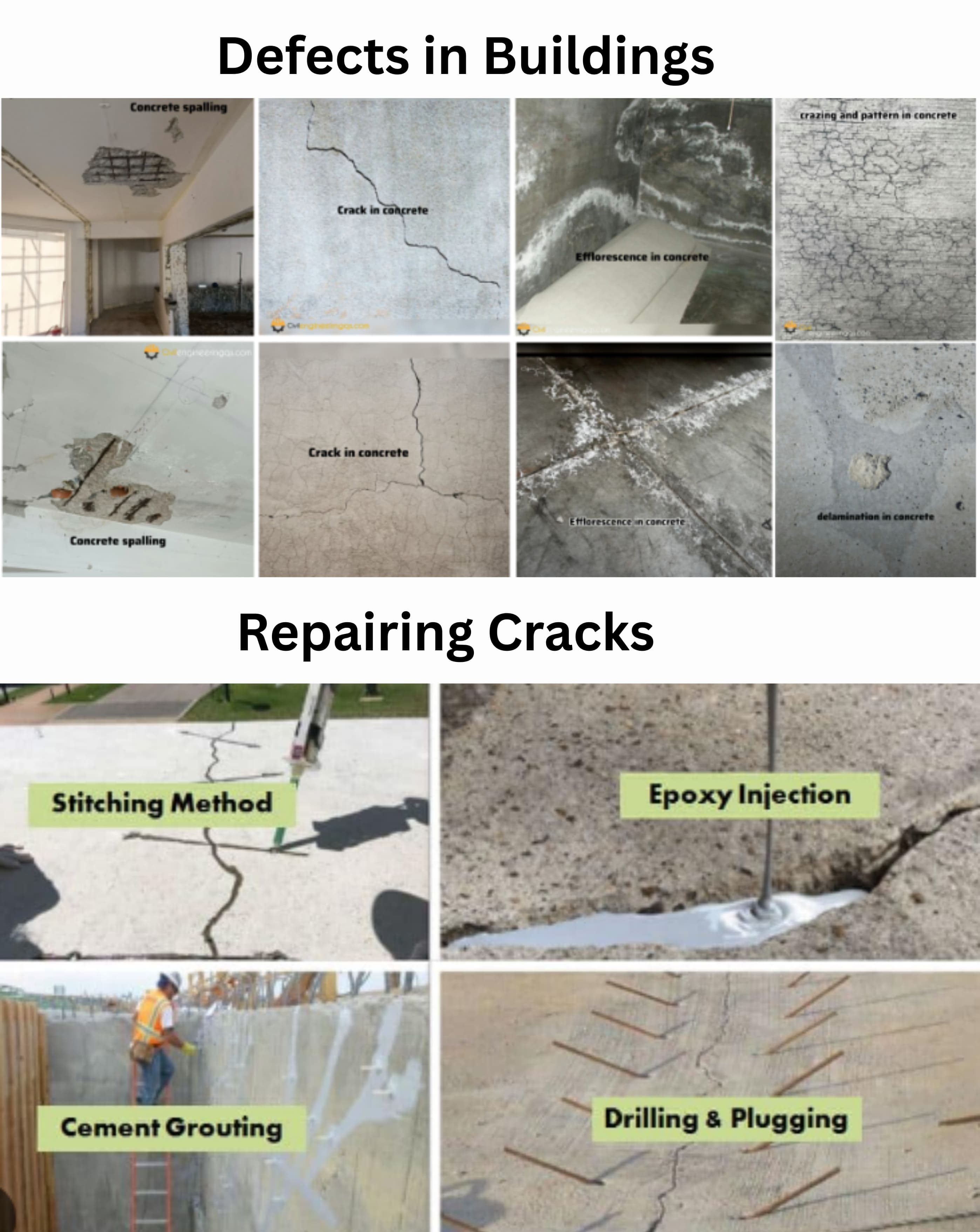
DEFECTS IN BUILDINGS
Other Chapters
FORMWORKFALSE CEILINGSTEEL STRUCTUREPRECAST CONSTRUCTION AND PRE-STRESSINGDEFECTS IN BUILDINGSTERMITE PROOFINGEarthquake IN BUILDINGS
- Q1: Name some commonly found defects in buildings.Ans: Some common building defects are:
- ➔ Cracks in walls, beams, columns, and slabs.
- ➔ Dampness and water leakage in walls and roofs.
- ➔ Efflorescence on brick or concrete surfaces.
- ➔ Peeling of paint and plaster.
- ➔ Corrosion of steel reinforcement.
- ➔ Settlement of foundation.
- ➔ Honeycombing in concrete.
- ➔ Roof defects such as ponding of water.
- Q2: Define Settlement in buildings.Ans: The failure or the dislocation of a portion of a structure due to unequal compression happening in the foundation.
- Q3: Define P.W.D.Ans: P.W.D stands for Public Works Department. This department is responsible for constructing and maintaining public infrastructure like roads, buildings, and water systems.
- Q4: State some causes of settlement in buildings.Ans: Some of the causes are:
- ➔ Weak bearing soil
- ➔ Poor compaction
- ➔ Changes in moisture content
- ➔ Maturing trees & vegetation
- ➔ Soil consolidation
- ➔ Defective building materials
- Q5: Define Uniform Settlement.Ans: Uniform settlement occurs when the entire building settles down evenly into the soil. All parts of the foundation move down by the same amount. It usually does not cause cracks or structural damage because the structure remains level.
- Q6: Define Tipping Settlement.Ans: Tipping settlement occurs when one side of a structure settles more than the other side, causing the building to tilt or lean. This happens due to uneven soil strength or uneven loading.
- Q7: Define Differential Settlement.Ans: Differential settlement occurs when different parts of a building settle by different amounts. This creates stress in the structure and can lead to cracks in walls, floors, and foundations.
- Q8: Define Crack.Ans: A crack is a complete or incomplete separation of concrete into two or more parts produced by breaking or fracturing.
- Q9: Define Minor Crack.Ans: A minor crack is a small and shallow crack that usually affects only the surface and doesn’t threaten the structure’s strength. For example: Plaster cracks.
- Q10: Define Major Crack.Ans: A major crack is a large and deep crack that can weaken a structure and compromise its safety. For example: Cracks in foundation.
- Q11: Define Active Crack.Ans: An active crack is a crack that continues to grow or change in width over time. It happens because the movement or stress in the structure is still present. Active cracks need monitoring and proper repair.
- Q12: Define Dormant Crack.Ans: A dormant crack is a crack that has stopped growing. It does not change in size because the movement or stress causing it has ended. Dormant cracks can usually be repaired safely without worrying about further movement.
- Q13: Define Hairline Crack.Ans: Hairline Crack is a very thin and narrow crack on the surface of a material, usually less than 0.3 mm wide. It is mostly superficial and does not affect the structural strength.
- Q14: Name some types of cracks.Ans: Some types of cracks are:
- ➔ Active & Dormant cracking
- ➔ Rust Cracking
- ➔ Shrinkage Cracking
- ➔ Settlement Cracking
- Q15: What are the causes of cracks?Ans: Cracks are caused due to:
- ➔ Structural deficiency
- ➔ Overloading
- ➔ Temperature and shrinkage effects
- ➔ Poor construction practice
- Q16: Name some commonly found cracks in the buildings.Ans: Some of the commonly found cracks are as follows:
- ➔ Hairline Cracks
- ➔ Settlement Cracks
- ➔ Diagonal Cracks
- ➔ Rust Cracks
- Q17: Define Temperature Cracking/Cracks.Ans: Temperature cracks occur due to changes in temperature. When materials expand in heat and contract in cold, stress develops, leading to cracks.
- Q18: Define Tension Cracking/Cracks.Ans: Tension cracks occur when a material is pulled apart by tensile forces. Since materials like concrete are weak in tension, cracks develop when tensile stress exceeds its strength.
- Q19: Define Plastic Shrinkage Cracking/Cracks.Ans: Plastic shrinkage cracks occur in fresh concrete before it hardens. They happen when water evaporates quickly from the surface, causing the concrete to shrink and crack.
- Q20: Define Expansion Cracking/Cracks.Ans: Expansion cracks occur when building materials expand due to heat, moisture, or chemical reactions. If there is no space for expansion, cracks develop.
- Q21: Define Shrinkage Cracking/Cracks.Ans: Shrinkage cracks occur when concrete or mortar loses moisture and reduces in volume after hardening. This reduction in size creates cracks.
- Q22: Define Settlement Cracking/Cracks.Ans: Settlement cracks occur when the foundation or soil beneath a building settles unevenly. This movement creates stress and leads to cracks in the structure.
- Q23: Define Rust Cracking/Cracks.Ans: Rust cracks occur when steel reinforcement inside concrete corrodes. As steel rusts, it expands, creating pressure inside the concrete and causing cracks.
- Q24: Define Structural Cracking/Cracks.Ans: Structural cracks occur due to failure or weakness in load-bearing elements like beams, columns, or slabs. These cracks affect the safety and stability of the structure.
- Q25: Define Thermally-Induced Cracking/Cracks.Ans: Thermally-induced cracks are cracks caused by temperature differences within a material. Uneven heating or cooling creates internal stress, which leads to cracking.
- Q26: Define Guniting.Ans: Guniting is a repair method in which a cement-sand mixture is sprayed at high speed onto a surface using compressed air. It is used to repair damaged concrete surfaces.
- Q27: Define Gunite.Ans: Gunite is a dry mixture of cement and sand that is sprayed with water through a nozzle at high pressure. It forms a strong and dense layer when applied to surfaces.
- Q28: Define Sealant.Ans: Sealant is a material used to fill gaps or joints between surfaces to prevent the passage of air, water, dust, or other substances. It helps to make structures airtight and watertight, providing protection and durability.
- Q29: Name 4 Sealants.Ans: Some of the sealants are:
- ➔ Silicone sealant
- ➔ Acrylic sealant
- ➔ Polyurethane sealant
- ➔ Bituminous sealant
- Q30: Write Blanket method of crack repairing.Ans: In the Blanket method, a fabric or mesh is placed over the crack and bonded with adhesive or resin to strengthen and prevent further cracking.
- Q31: Write Jacketting method of crack repairing.Ans: Jacketting is a repair method in which additional concrete, steel, or other strong material is provided around an existing structural member like a column or beam. This increases its strength and load-carrying capacity. The damaged surface is cleaned, reinforcement is added if needed, and then new concrete is placed around it.
- Q32: Write Stitching method of crack repairing.Ans: Stitching is a method used to repair large cracks by inserting steel bars or U-shaped metal staples across the crack. Holes are drilled on both sides of the crack, steel bars are fixed with grout or epoxy, and the crack is sealed. This helps hold the cracked parts together.
- Q33: What are Epoxies?Ans: Epoxies are strong adhesive chemical compounds used for bonding and repairing cracks in concrete. They have high strength, good bonding ability, and resist water and chemicals. Epoxies are commonly used for crack filling and structural repairs.
- Q34: Define Grouting.Ans: Grouting is a repair process in which a fluid material called grout (cement-based or chemical) is injected into cracks, voids, or gaps to fill them and strengthen the structure. It improves stability and prevents water leakage.
- Q35: Define Expansion Joints.Ans: Expansion joints are gaps or spaces intentionally provided in structures (like buildings, bridges, roads, and pipelines) to allow for the expansion and contraction of materials due to temperature changes, moisture, or other factors. These joints prevent cracks, structural damage, and deformation by absorbing movements.
- Q36: Define Base Isolated.Ans: Base isolated refers to a structural engineering technique used to protect buildings from earthquake damage. In this method, the building is separated from its foundation using flexible bearings or pads, called base isolators.
- Q37: Name some methods used to repair cracks.Ans: Some of the methods are:
- ➔ Using Epoxies
- ➔ Grouting
- ➔ Stitching
- ➔ Blanketing
- ➔ External Stressing
- Q38: Define Dampness.Ans: Presence of unwanted moisture in the structure of a building is called dampness.
- Q39: Write some causes of dampness in buildings.Ans: Some of the causes are as follows:
- ➔ Rising of groundwater through foundation due to absence of proper DPC.
- ➔ Rainwater penetration through walls, roofs, or cracks.
- ➔ Leakage from pipes, bathrooms, or water tanks.
- ➔ Poor drainage system around the building.
- ➔ Condensation due to poor ventilation.
- ➔ Use of low-quality or porous building materials.
- Q40: Define Seepage.Ans: Seepage is the slow movement of water through small pores, cracks, or joints in walls, floors, or roofs. It causes dampness and may damage the building over time.
- Q41: Define D.P.C.Ans: D.P.C. (Damp Proof Course) is a protective layer of waterproof material provided at the base of walls to prevent moisture from rising from the ground into the building.
- Q42: How is guniting done to prevent dampness?Ans: A mixture of cement and water is forced by a cement gun onto the surface. Then a 1:3 or 1:4 cement mortar is applied with pressure using compressed air to create an impervious layer.
- Q43: Define WaterproofingAns: Waterproofing is the process of making a structure or surface resistant to water penetration. It prevents water from entering or passing through walls, roofs, basements, or other parts of a building, thereby protecting it from leakage, dampness, and damage.
- Q44: Write some general guidelines of water proofing.Ans: General guidelines include:
- ➔ Keep building materials dry
- ➔ Provide a clear path for water to exit roofs
- ➔ Install proper insulation in wall cavities
- ➔ Avoid placing pipes in exterior walls
- ➔ Use water-resistive barriers behind showers
- ➔ Dry concrete floors before covering
- ➔ Ventilate during construction
- Q45: Name some methods used to detect dampness in a building.Ans: Some of the methods are:
- ➔ Pressure Diagnostics
- ➔ Polyethylene Test
- ➔ Standing Water Test
- ➔ Spray Test
- Q46: Name some methods used to prevent dampness.Ans: Some of the methods are:
- ➔ Providing D.P.C. course
- ➔ Providing cavity walls
- ➔ Surface treatment
- ➔ Integral treatment
- ➔ Guniting
- ➔ Pressure grouting
- Q47: Write some effects of dampness in buildings.Ans: Some common effects are:
- ➔ Peeling of paint or plaster
- ➔ Growth of mold and fungus
- ➔ Rusting of metal parts
- ➔ Damage to wooden structures
- ➔ Unpleasant smell and unhealthy environment
- ➔ Weakening of the building structure
- Q48: What is Freeze-Thaw Deterioration?Ans: Freeze-thaw deterioration is damage that occurs when water enters cracks or pores of concrete or masonry, freezes in cold weather, and expands. This repeated freezing and thawing creates internal pressure, leading to cracks and surface damage.
- Q49: What is a Cavity Wall?Ans: A cavity wall is a wall made of two separate layers (inner and outer walls) with a gap or cavity between them. The cavity helps prevent moisture from passing from the outer wall to the inner wall and also improves thermal insulation.
- Q50: What is Rising Damp?Ans: Rising damp is the upward movement of groundwater through walls and floors due to capillary action. It usually occurs when there is no proper Damp Proof Course (DPC) in the building.
- Q51: What is Lateral Damp?Ans: Lateral damp is moisture that enters the building from the sides, usually through basement walls or retaining walls. It happens when soil moisture pushes horizontally against the wall.
- Q52: What is Condensation Damp or Mould?Ans: Condensation damp occurs when warm moist air inside a building comes in contact with cold surfaces, forming water droplets. This moisture leads to mould growth, stains, and damage to walls and ceilings.
- Q53: Define Efflorescence.Ans: Efflorescence is a white powdery deposit that appears on the surface of bricks, concrete, or plaster. It is caused by soluble salts carried to the surface by water, which remain after the water evaporates.
- Q54: Define Compaction.Ans: Compaction is the process of increasing the density of soil by reducing air voids using mechanical means like ramming or rolling. It improves the strength and stability of the soil.
- Q55: Define Consolidation.Ans: Consolidation is the gradual reduction in volume of saturated soil due to the removal of water from its pores under sustained load. It results in settlement over time.
- Q56: What is Sick Building Syndrome?Ans: Sick Building Syndrome (SBS) is a condition in which the occupants of a building experience health problems such as headache, dizziness, eye irritation, cough, or fatigue due to poor indoor air quality. It is usually caused by poor ventilation, indoor pollutants, mould, or improper maintenance of the building.